Definitions [34]
The closed surface over which the surface integral of the electric field intensity (i.e. total electric flux) is considered in Gauss' Law is called a Gaussian surface.
The study of electricity/electric charges at rest is called electrostatics.
A Gaussian surface is an imaginary, closed mathematical surface chosen to apply Gauss's Law conveniently.
The work done by an external force in bringing a unit positive charge from infinity to that point is called electric potential at that point.
The work done against the electrostatic forces to achieve a certain configuration of charges in a given system is called electrostatic potential energy.
"Potential difference is the work done to move a unit charge from one point to another in an electric field."
OR
The difference in electric potential between two points B and A, given by ΔV = VB − VA = \[\frac {W_AB}{q_0}\], is called potential difference.
The work done by an external agent in bringing a unit positive test charge slowly from infinity to a point in an electric field, against the electrostatic force, is called the electric potential at that point.
The straight line passing through both charges, +q and −q, of a dipole is called the dipole axis.
A system consisting of two equal and opposite point charges (+q and −q) separated by a small distance (2a) is called an electric dipole.
The vector quantity equal to the product of the magnitude of either charge and the distance between the two charges, directed from −q to +q, is called the dipole moment.
The surface at which electric potential is the same at each point is called an equipotential surface.
OR
Any surface over which the electric potential is the same everywhere is called an equipotential surface.
Conductors are those through which electric charge can easily flow. Metals, human body, earth, mercury and electrolytes are conductors of electricity.
OR
The material through which electric charge can flow easily is called a conductor.
Those substances in which electric charge cannot flow are called ‘insulators' (or dielectrics). Glass, hard-rubber, plastics and dry wood are insulators. Insulators have practically no free electrons.
OR
The material in which electrons are tightly bound to the nucleus and thus not available for conductance is called an insulator.
OR
Substances which offer high resistance to the passage of electricity and do not allow electricity to pass through them easily, are called insulators.
Substances whose resistance to the movement of charges is intermediate between conductors and insulators, are called semiconductors.
Charges that are tightly bound to atoms/molecules and cannot migrate through the material. They can only undergo small displacement or realignment, producing polarisation.
Example: electrons bound to atomic nuclei in a dielectric.
Charges that are loosely bound to atoms/molecules and can move freely through a material when an external electric field is applied.
Example: conduction electrons in metals, ions in electrolytes.
A molecule in which the centres of positive and negative charge coincide, so the net dipole moment is zero in the absence of an external field (e.g., N₂, O₂, CO₂).
A molecule in which the centres of positive and negative charge do not coincide, giving it a permanent dipole moment even without an external field (e.g., H₂O, HCl, NH₃).
A dielectric is a non-conducting substance in which, on the application of an external electric field, induced charges appear that oppose (but do not cancel) the applied field.
A dielectric made of polar molecules; in the absence of a field, molecular dipoles are randomly oriented, giving zero net dipole moment overall.
A dielectric made of non-polar molecules; an external field induces a temporary dipole moment in each molecule, aligned with the field.
Electric Polarisation is the phenomenon in which an external electric field induces or aligns molecular dipoles within a dielectric, producing equal and opposite bound surface charges on its faces.
Dielectric Constant (K) is the ratio of the applied field to the net field inside the dielectric, indicating how much the material reduces the electric field.
Dielectric Strength is the maximum electric field a dielectric can withstand without electrical breakdown (i.e., before it starts conducting).
The ratio of the charge Q given to one of the conductors of a capacitor to the potential difference V between the conductors is called its capacitance, given by C = Q/V.
The maximum electric field that a dielectric medium can withstand without breakdown (of its insulating property) is called its dielectric strength.
A system consisting of two conductors having equal and opposite charges separated by an insulator or dielectric is called a capacitor.
The ability of a conductor to store charge is called the capacity of conductor.
The capacitance of a single capacitor that stores the same charge at the same voltage as the entire combination is called the equivalent capacitance of the combination.
The work done per unit charge in moving a charge from one plate of a capacitor to the other is called the potential difference between the plates.
A parallel plate capacitor in which a dielectric slab is inserted between the plates to increase its capacitance by reducing the electric field between the plates is called a capacitor with a dielectric medium.
The current that exists at any point in space where a time-varying electric field (E) exists, i.e., \[\frac {dE}{dt}\] ≠ 0, is called displacement current (iₐ).
The work done in the transfer of charge q between the two plates of a capacitor, which gets stored in the form of potential energy of the system, is called the energy stored in a capacitor.
A device used to develop very high potentials of the order of 107 volts is called a Van de Graaff generator.
Formulae [16]
Potential difference (V) between two points = Work done (W)/Charge (Q)
V = \[\frac {W}{Q}\]
The SI unit of electric potential difference is volt (V)
1 volt = \[\frac{1\mathrm{~joule}}{1\mathrm{~coulomb}}\] = 1 J C-1
\[V(r)=\frac{1}{4\pi\varepsilon_0K}\frac{q}{r}\]
- V(r) = electric potential at distance rr from the charge
- q = source charge
- ε0 = permittivity of free space
- K = dielectric constant of medium
- Reference is taken such that V(∞) = 0.
For a system of n point charges q1, q2, q3,…, qn, the total electric field at point P is:
E(r) = \[{\frac{1}{4\pi\varepsilon_0}\sum_{i=1}^n\frac{q_i}{r_{iP}^2}\hat{\mathbf{r}}_{iP}}\]
Symbol Reference
| Symbol | Meaning |
|---|---|
| E(r) | Resultant electric field at point P |
| qi | The i-th source charge in the system |
| riP | Distance from charge qi to point P |
| \[\hat r_i\]P | Unit vector directed from qi toward point P |
| ε0 | Permittivity of free space |
| \[\frac {1}{4πε_0}\] | Coulomb's constant ≈ 9 × 10⁹ Nm²C⁻² |
When a charge q0 is moved from point A to point B on the same equipotential surface:
Since VA = VB on the surface:
E = E0 − Einduced
Dielectric constant (relative permittivity):
K = \[\frac {ε}{ε_0}\]
where ε is the permittivity of the medium and ε0 is the permittivity of free space.
It can also be expressed as:
Eds = \[\frac {V_{max}}{d}\]
SI unit: V/m
K = \[\frac {E_0}{E}\]
K = \[\frac {\sigma}{\sigma-\sigma_i}\]
where σ = surface charge density on plates, σi = induced (bound) charge density.
C = 4πkε₀ · [\[\frac {ab}{(b − a)}\]]
C = \[\frac {2πkε₀ l}{2.303 log(b/a)}\]
C = Q/V
\[{C_P=C_1+C_2+C_3+\cdots}\]
For n identical capacitors of capacitance C each: CP = nC
Physical Insight: Adding capacitors in parallel is like adding more storage tanks — the total storage capacity simply increases.
For two capacitors in series, the voltage across each is:
\[V_1=\frac{C_2}{C_1+C_2}\cdot V\]
\[V_2=\frac{C_1}{C_1+C_2}\cdot V\]
Physical Insight: The smaller the capacitor, the larger the voltage drop across it in a series combination. This is why identical series capacitors share voltage equally.
\[{\frac{1}{C_S}=\frac{1}{C_1}+\frac{1}{C_2}+\frac{1}{C_3}+\cdots}\]
For n identical capacitors of capacitance C each: CS = \[\frac {C}{n}\]
\[\frac {dE}{dt}\] ≠ 0 ⇒ id exists
W = \[\frac {1}{2}\]qV
OR
U = \[\frac {Q^2}{2C}\] = \[\frac {1}{2}\]QV = \[\frac {1}{2}\]CV2
SI unit: Joule (J)
Theorems and Laws [5]
State Gauss’s law on electrostatics and drive expression for the electric field due to a long straight thin uniformly charged wire (linear charge density λ) at a point lying at a distance r from the wire.
Gauss' Law states that the net electric flux through any closed surface is equal to `1/epsilon_0` times the net electric charge within that closed surface.
`oint vec" E".d vec" s" = (q_(enclosed))/epsilon_o`
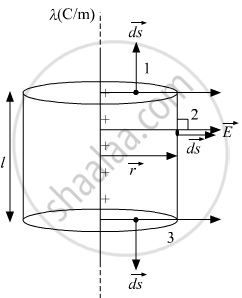
In the diagram, we have taken a cylindrical gaussian surface of radius = r and length = l.
The net charge enclosed inside the gaussian surface `q_(enclosed) = lambdal`
By symmetry, we can say that the Electric field will be in radially outward direction.
According to gauss' law,
`oint vec"E".d vec"s" = q_(enclosed)/epsilon_o`
`int_1 vec"E" .d vec"s" + int_2 vec"E" .d vec"s" + int_3 vec"E". d vec"s" = (lambdal)/epsilon_o`
`int_1 vec"E". d vec"s" & int_3 vec"E". d vec"s" "are zero", "Since" vec"E" "is perpendicular to" d vec"s"`
`int_2 vec"E" . d vec"s" = (lambdal)/epsilon_o`
`"at" 2, vec"E" and d vec"s" "are in the same direction, we can write"`
`E.2pirl = (lambdal)/epsilon_o`
`E = lambda/(2piepsilon_o r)`
"The total electric flux through any closed surface is equal to \[\frac {1}{ε_0}\] times the net charge enclosed by that surface."
Three Forms of the Law
1. Verbal Form:
The net outward electric flux through a closed surface equals the net enclosed charge divided by ε₀.
2. Algebraic Form:
ΦE = \[\frac {Q_enc}{ε_0}\]
3. Integral Form:
\[\oint\vec{E}\cdot d\vec{S}=\frac{Q_{\mathrm{enc}}}{\varepsilon_0}\]
Variable Legend
| Symbol | Meaning | SI Unit |
|---|---|---|
| ∮ | Closed surface integral | — |
| E | Electric field at the surface | N C⁻¹ |
| dS | Area element vector (outward normal) | m² |
| Qenc | Net charge enclosed by the surface | Coulomb (C) |
| ε0 | Permittivity of free space = 8.85 × 10⁻¹² C² N⁻¹ m⁻² | C² N⁻¹ m⁻² |
"The electric field at any point due to a group of charges is the vector sum of the electric fields at that point due to each individual charge, calculated as if the other charges were not present."
- Each charge in the system contributes its own independent electric field at the point of interest.
- These individual fields are then added vectorially to give the total (resultant) field.
\[\oint_c\vec{B}\cdot d\vec{l}=\mu_0I_c+\varepsilon_0\mu_0\frac{d\Phi_E}{dt}\]
This equation states that not only the current but also the changing electric field produces a changing magnetic field. This equation is known as the Ampere-Maxwell Circuital Law.
Works on:
- Corona discharge
- Charge distribution on a hollow conductor (outer surface)
- A continuous supply of charge increases potential
- Can generate potentials of order 107 volts.
Key Points
- Applicable to any closed surface, regardless of shape or size — sphere, cube, irregular shape
- Only enclosed charges contribute to the net flux; external charges do not
- The electric field E at the Gaussian surface is due to all charges (inside and outside), but the net flux depends only on enclosed charge
- Gauss's Law is valid for both stationary and moving charges
- It is one of Maxwell's four equations of electromagnetism
- Gauss's Law can be derived from Coulomb's Law for static charges, and vice versa — both are equivalent
- If net enclosed charge = 0, net flux = 0 (but E ≠ 0 necessarily)
- Electric potential at a point is the work done per unit positive test charge in bringing it slowly from infinity to that point, against the electric field.
- For a point charge q in air/vacuum:
V(r) = \[\frac{1}{4\pi\varepsilon_0}\frac{q}{r}\] - In a medium of dielectric constant K:
V(r) = \[\frac{1}{4\pi\varepsilon_0K}\frac{q}{r}\] - Positive charge produces positive potential; negative charge produces negative potential.
- Potential due to a point charge is spherically symmetric and depends only on distance r.
- Distance dependence:
F ∝ 1/r2, E ∝ 1/r2, V ∝ 1/r. - The potential at infinity is taken as zero; only potential differences are physically significant.
- The electrostatic field is conservative, so the work done in moving a charge between two points is path independent.
- The resultant field E is the vector sum of all individual fields.
- Each individual field Ei is calculated independently, as if no other charges exist.
- The unit vector \[\hat r_i\]P points from each charge qi toward point P.
- The principle holds for any number of charges in any configuration.
- This is a direct application of the Superposition Principle to electric fields.
- Conductors allow charge to flow easily; insulators resist it strongly.
- In metals, free electrons carry charge; in electrolytes, ions carry it.
- Charge spreads across a conductor's surface but stays localized on an insulator.
- Semiconductors lie between the two and are sensitive to heat/doping.
- Insulators can still polarize under an electric field without conducting current.
- Free charges → conductors → net internal field = 0.
- Bound charges → dielectrics → polarisation, not conduction.
- Bound charges never leave their parent atom/molecule.
- Polarisation charge is also called induced charge.
- Free charges are the basis of electric current; bound charges are the basis of dielectric behaviour.
- Dielectrics polarise but do not conduct; induced charges oppose (not cancel) the external field.
- Polar dielectrics: pre-existing dipoles align with the field.
- Non-polar dielectrics: dipoles are induced by the field.
- Dielectric constant K = ε/ε0 = E0/E; always K > 1.
- Used in capacitors to reduce field and boost capacitance.
- Capacitance depends on the geometry (shape, size, separation) of the conductors and on the dielectric between them.
- In a series, the charge on each capacitor is the same, but the voltage across each is different.
- A series combination divides high voltage — the capacitor with the smallest capacitance gets the largest P.D., and it cannot store much charge.
- In parallel, the voltage across each capacitor is the same, but the charge on each is different, and it handles only low voltage.
- A parallel combination is used when a large capacitance at low potential is needed, as it can store a large amount of charge.
Capacitors in Series:
Equivalent capacitance: \[\frac{1}{C_s}=\frac{1}{C_1}+\frac{1}{C_2}+\frac{1}{C_3}+\cdots\]
- Same voltage (V) across all capacitors
- Charge divides
- The equivalent capacitance is greater than the largest capacitor
Capacitors in Parallel:
\[C_p=C_1+C_2+C_3+\cdots\]
- Same voltage (V) across all capacitors
- Charge divides
- The equivalent capacitance is greater than the largest capacitor
Concepts [19]
- Concept of Electrostatics
- Gauss’s Law
- Application of Gauss' Law
- Electric Potential and Potential Difference
- Electric Potential Due to a Point Charge
- Electric Field due to an Electric Dipole
- Electric Field Due to a System of Charges
- Equipotential Surfaces
- Electrical Energy of Two Point Charges and of a Dipole in an Electrostatic Field
- Conductors and Insulators
- Free and Bound Charges
- Dielectrics
- Electric Polarisation of Dielectrics
- Capacitors and Capacitance
- Combination of Capacitors
- Capacitance of a Parallel Plate Capacitor with and Without Dielectric Medium Between the Plates
- Displacement Current
- Energy Stored in a Charged Capacitor
- Van De Graaff Generator
