English Medium
Academic Year: 2025-2026
Date & Time: 7th March 2026, 10:30 am
Duration: 3h
Advertisements
General Instructions:
Read the following instructions carefully and strictly follow them:
- This question paper contains 38 questions. All questions are compulsory.
- Question paper is divided into FOUR sections - Section A, B, C and D. Each Section carries 20 marks.
- Section A: History
- Section B: Geography
- Section C: Political Science
- Section D: Economics
- This question paper has MCQs, VSAs, SAs, LAs and CBQs.
- Multiple Choice Questions (MCQs) carry 1 mark each.
- Very Short Answer Type Questions (VSAs) carry 2 marks each. Answer to each question should not exceed 40 words.
- Short Answer Type Questions (SAs) carry 3 marks each. Answer to each question should not exceed 60 words.
- Long Answer Type Questions (LAs) carry 5 marks each. Answer to each question should not exceed 120 words.
- There are Cases Based questions (CBQs) with three sub-questions and are of 4 marks each. Answer to each question should not exceed 100 words.
- The map-based questions (two questions) carry five marks-
- Section A - (History) - 2 marks
- Section B - (Geography) - 3 marks
- Divide your answer sheet into four sections as per question paper - Section A (History), Section B (Geography), Section C (Political Science), and Section D (Economics).
- It is compulsory to answer each question in its respective section.
- Do not mix answer of one section into the other section.
- Instructions are given with each section and question, wherever necessary.
- Kindly note that a separate question has been provided for visually impaired candidates in lieu of questions having visual inputs, map etc. Such questions are to be attempted by Visually Impaired candidates only.
- There is no overall choice in the question paper. However, an internal choice has been provided in few questions. Only one of the choices in such questions has to be attempted.
The given painting is from the sixteenth century, from Mughal India. Identify the work shown in this painting from the following options:
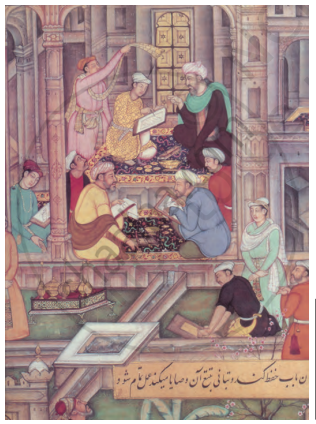
Minting of coins
Metal crafting
Pottery making
Book making
Chapter:
Which one of the following pairs is correctly matched?
| Column - A (Writer) |
Column - B (Contribution) |
| Ram Chaddha | Bengal Gazette |
| Column - A (Writer) |
Column - B (Contribution) |
| Gangadhar Bhattacharya | Kesari |
| Column - A (Writer) |
Column - B (Contribution) |
| Jyotiba Phule | Gulamgiri |
| Column - A (Writer) |
Column - B (Contribution) |
| Rashsundari Devi | Padmarg |
Chapter:
Assertion (A): Silver from Peru and Mexico enhanced Europe’s wealth in the sixteenth century.
Reason (R): Europe used this silver to finance its trade with Asia.
Both (A) and (R) are true and (R) is the correct explanation of (A).
Both (A) and (R) are true, but (R) is not the correct explanation of (A).
(A) is true, but (R) is false.
(A) is false, but (R) is true.
Chapter:
Arrange the following events in chronological order and choose the correct option:
- Second Round Table Conference
- Formation of Depressed Class Association
- Lahore Session of Indian National Congress
- Formation of Awadh Kissan Sabha
I, II, IV, III
I, II, III, IV
IV, III, II, I
IV, III, I, II
Chapter:
“Food offered many examples of long distance cultural exchange during pre-modern times.” Explain the statement with any two examples.
Chapter:
“Trade and cultural exchange went hand-in-hand during pre-modern times.” Explain the statement with any two examples.
Chapter:
Evaluate the role of print in the French Revolution.
Chapter:
Evaluate the role of Buddhist Missionaries in printing culture.
Chapter:
Describe the role of the Balkans in the outbreak of World War - I.
Chapter:
Describe the role of European artists in promoting nationalism during nineteenth century.
Chapter:
Read the given source carefully and answer the questions that follow:
|
Quit India Movement The failure of the Cripps Mission and the effects of World War II created widespread discontentment in India. This led Gandhiji to launch a movement calling for complete withdrawal of the British from India. The Congress Working Committee, in its meeting in Wardha on 14 July 1942, passed the historic ‘Quit India’ resolution demanding the immediate transfer of power to Indians and quit India. On 8th August 1942 in Bombay, the All India Congress Committee endorsed the resolution which called for a non-violent mass struggle on the widest possible scale throughout the country. It was on this occasion that Gandhiji delivered the famous ‘Do or Die’ speech. The call for ‘Quit India’ almost brought the state machinery to a standstill in large parts of the country as people voluntarily threw themselves into the thick of the movement. People observed hartals, and demonstrations and processions were accompanied by national songs and slogans. The movement was truly a mass movement which brought into its ambit thousands of ordinary people, namely students, workers and peasants. It also saw the active participation of leaders, namely, Jayprakash Narayan, Aruna Asaf Ali and Ram Manohar Lohia and many women such as Matangini Hazra in Bengal, Kanaklata Barua in Assam and Rama Devi in Orissa. The British responded with much force, yet it took more than a year to suppress the movement. |
- How did the failure of the Cripps Mission contribute to the launch of the Quit India Movement? (1)
- Why was Gandhiji’s call for the ‘Quit India’ considered historic? (1)
- Explain the role of women in making the Quit India Movement more inclusive. (2)
Chapter:
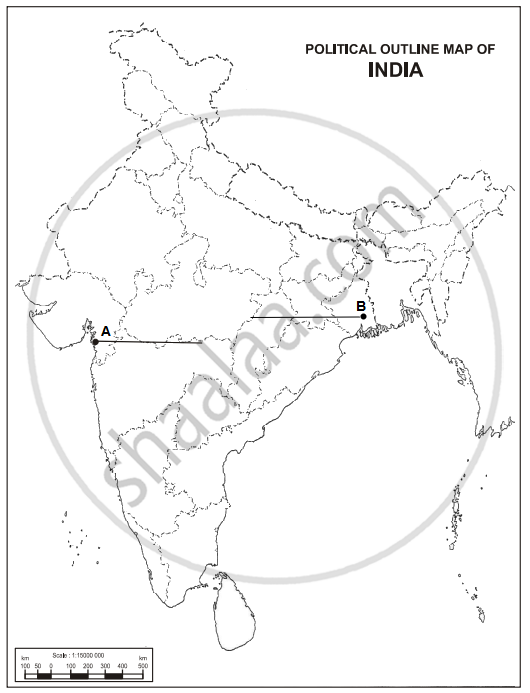
Two places ‘A’ and ‘B’ have been marked on the given political outline map of India. Identify them with the help of the following information and write their correct names on the lines drawn near them:
- The place where Gandhiji broke the Salt Law. (1)
- The place where the session of Indian National Congress was held. (1)
Chapter:
Which one of the following crops grows well in hot and humid climate?
Sugarcane
Peas
Wheat
Gram
Chapter:
In which of the following categories of ‘land-use’ has India registered an increase?
Permanent pasture
Unsuitable for agriculture
Barren
Forest
Chapter:
Advertisements
Choose the correct option to fill in the blank:
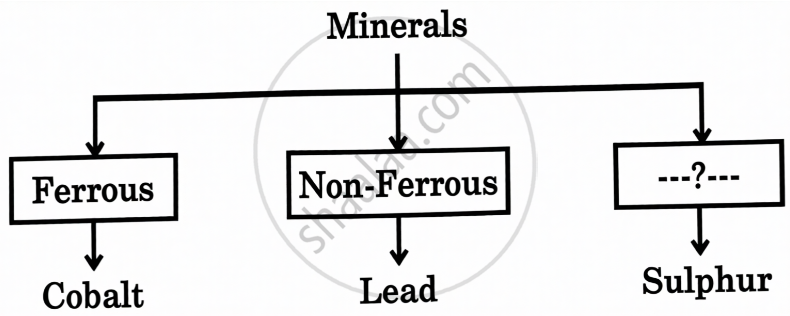
Non-metallic
Metallic
Precious
Energy
Chapter:
Match Column - I with Column - II and choose the correct option:
| Column - I (National Park) |
Column - II (States) |
| a. Corbett | i. Rajasthan |
| b. Sunderban | ii. Uttarakhand |
| c. Sariska | iii. Kerala |
| d. Periyar | iv. West Bengal |
a - ii, b - i, c - iv, d - iii
a - i, b - iii, c - ii, d - iv
a - iv, b - ii, c - iii, d - i
a - ii, b - iv, c - i, d - iii
Chapter:
In which of the following regions did the “Beej-Bachao Andolan” of farmers begin?
Kumaon
Tehri
Almora
Chapter:
Read the given infographics carefully and choose the correct option that identifies the soil described.

Laterite soil
Forest soil
Arid soil
Black soil
Chapter:
If every farmer in India follows modern farming practices, explain any two positive changes this could bring to villages.
Chapter:
Examine the importance of Bio-gas energy in rural areas.
Chapter:
Examine the significance of natural gas for industrial usage.
Chapter:
Read the given source and answer the questions that follow:
|
Sardar Sarovar Project
Sardar Sarovar Dam has been built over the Narmada river in Gujarat. This is one of the largest water resources projects of India covering four states - Maharashtra, Madhya Pradesh, Gujarat and Rajasthan. The Sardar Sarovar Project would meet the requirement of water in drought prone and desert areas. Sardar Sarovar Project will provide irrigation facilities to 18.45 lakh hectare of land, covering 3112 villages in 15 districts of Gujarat. It will also irrigate 2,46,000 hectare of land in the strategic desert districts of Barmer and Jalore in Rajasthan and 37,500 hectare in the tribal hilly tract of Maharashtra through lift. About 75% of the command area in Gujarat is drought prone while entire command in Rajasthan is drought prone. Assured water supply will soon make this area drought proof.
|
- Why is Sardar Sarovar Project considered important for Gujarat? (1)
- Why is Sardar Sarovar Project designed to cover four states? (1)
- In what ways does this project promote sustainability? (2)
Chapter:
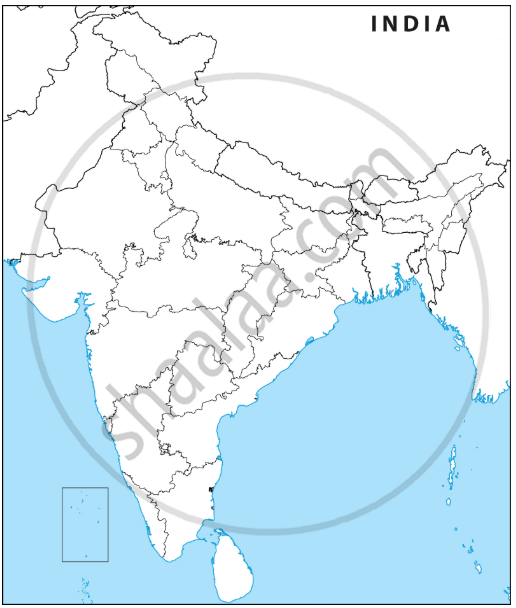
On the given outline map of India, locate and label any three of the following with suitable symbols:
- The major dam constructed on the Chenab river (1)
- Nuclear power plant in Maharashtra (1)
- Software Technology Park in Tamil Nadu (1)
- International Airport in Punjab (1)
Chapter:
Look at the given picture carefully and choose the most appropriate option:
Which of the following is a strength of democracy highlighted in the cartoon?
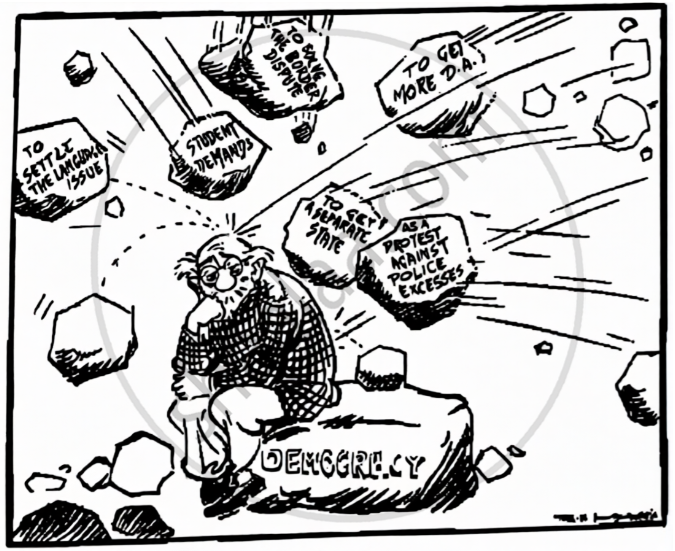
Avoidance of social conflicts
Quick decision-making
Concentration of power with one
Thinking accommodation of various demands
Chapter:
- Rural local government is known as Panchayati Raj.
- Each village or group of villages have Gram Panchayat.
- Panch and Sarpanch of villages are selected by Election Commission.
- Panchayat works under the supervision of Gram Sabha.
Only i, iii and iv are correct.
Only i, ii and iv are correct.
Only ii, iii and iv are correct.
Only i, ii and iii are correct.
Chapter:
Find the odd one out from the following:
Communist Party of India (M) & Bharatiya Janata Party
Rashtriya Janata Dal & Janata Dal
Nationalist Congress Party & Shiv Sena
United Democratic Party & National People's Party
Chapter:
Assertion (A): The civil war in Sri Lanka resulted due to failure of political accommodation of ethnicity.
Reason (R): The distrust between the Sinhala and Tamil communities turned into widespread conflict in Sri Lanka.
Both (A) and (R) are correct and (R) is the correct explanation of (A).
Both (A) and (R) are correct, but (R) is not the correct explanation of (A).
(A) is true, but (R) is false.
(A) is false, but (R) is true.
Chapter:
Suggest two measures to ensure equal opportunities for women in all professions.
Chapter:
Advertisements
Differentiate between democracy and dictatorship.
Chapter:
How does the Indian Constitution define the distribution of powers between the centre and the states? Explain with examples.
Chapter:
“Political parties are one of the most visible institutions in a democracy.” Examine the statement.
Chapter:
“There are many challenges before the political parties.” Examine the statement.
Chapter:
Read the given source carefully and answer the questions that follow:
|
Power Sharing Power is shared among different organs of government, such as the legislature, executive and judiciary. Let us call this horizontal distribution of power because it allows different organs of government placed at the same level to exercise different powers. Such a separation ensures that none of the organs can exercise unlimited power. Each organ checks the others. This results in a balance of power among various institutions. Last year, we studied that in a democracy, even though ministers and government officials exercise power, they are responsible to the Parliament or State Assemblies. Similarly, although judges are appointed by the executive, they can check the functioning of executive or laws made by the legislatures. This arrangement is called a system of checks and balances.
|
- Explain the term ‘Balance of Power’. (1)
- Why is the judiciary considered independent in a democracy? (1)
- How is power shared among different organs of government? (2)
Chapter:
Which of the following reports compare countries using health, education and per capita income?
Human Development Report
Global Trade Report
World Development Report
Economic Survey Report
Chapter:
The removal of barriers on foreign trade and investment by the Indian government has been called as ______.
Industrialisation
Nationalisation
Privatisation
Liberalisation
Chapter:
Read the given case and choose the correct option:
| Swapna, a small farmer grows groundnut on her three acres of land. She takes a loan from the moneylender to meet the expenses of cultivation but midway due to flood, crop fails and her debt increased. Again she has to take loan to manage crops. |
Suggest Swapna, which of the following sources of loan would be suitable for her.
Friends
Relatives
Moneylenders
Banks
Chapter:
Identify the sector of the economy on the basis of ownership with the help of following information:
|
Private Sector
Public Sector
Joint Sector
Cooperative Sector
Chapter:
Study the given data carefully and answer the question that follows:
| Country | Monthly income of citizens in ₹ | |||||
| I | II | III | IV | V | AY | |
| A | 9,500 | 10,500 | 9,800 | 1,000 | 10,200 | |
| B | 500 | 500 | 500 | 500 | 4,800 | |
Identify the average monthly income of citizens in country A.
8,200
9,000
1,000
9,020
Chapter:
Net attendance ratio is expressed as a ______ of total children in the age group of 6 - 10 years attending school.
Ratio
Percentage
Fraction
Index
Chapter:
“New technology has helped to connect the world.” Justify the statement with suitable arguments.
Chapter:
Why is credit important for economic development? Explain.
Chapter:
Analyse the issues that necessitate sustainable development for the future.
Chapter:
Explain the role of the secondary sector in an economy.
Chapter:
Explain the role of tertiary sector in an economy.
Chapter:
Other Solutions
Submit Question Paper
Help us maintain new question papers on Shaalaa.com, so we can continue to help studentsonly jpg, png and pdf files
CBSE previous year question papers Class 10 Social Science with solutions 2025 - 2026
Previous year Question paper for CBSE Class 10 Social Science-2026 is solved by experts. Solved question papers gives you the chance to check yourself after your mock test.
By referring the question paper Solutions for Social Science, you can scale your preparation level and work on your weak areas. It will also help the candidates in developing the time-management skills. Practice makes perfect, and there is no better way to practice than to attempt previous year question paper solutions of CBSE Class 10.
How CBSE Class 10 Question Paper solutions Help Students ?
• Question paper solutions for Social Science will helps students to prepare for exam.
• Question paper with answer will boost students confidence in exam time and also give you an idea About the important questions and topics to be prepared for the board exam.
• For finding solution of question papers no need to refer so multiple sources like textbook or guides.
