Science (English Medium)
Academic Year: 2021-2022
Date & Time: 10th December 2021, 11:30 am
Duration: 1h30m
Advertisements
General Instructions:
- This question paper contains 55 questions out of which 45 questions are to be attempted. All questions carry equal marks.
- The question paper consists of three Sections - Section A, B and C.
- Section - A contains 25 questions. Attempt any 20 questions from Q. No. 01 to 25.
- Section - B contains 24 questions. Attempt any 20 questions from Q. No. 26 to 49.
- Section - C contains 6 questions. Attempt any 5 questions from Q. No. 50 to 55.
- The first 20 Questions attempted in Section - A & Section - B and first 5 questions attempted in Section - C by a candidate will be evaluated.
- There is only one correct option for every multiple choice question (MCQ) Marks will not be awarded for answering more than one option.
- There is no negative marking.
A negatively charged object X is repelled by another charged object Y. However an object Z is attracted to object Y. Which of the following is the most possibility for the object Z?
positively charged only
negatively charged only
neutral or positively charged
neutral or negatively charged
Chapter:
In an experiment three microscopic latex spheres are spread into a chamber and became charged with charges +3e, +5e and −3e respectively. All the three spheres came in contact simultaneously for a moment and got separated. Which one of the following are possible values for the final charge on the spheres?
+5e, −4e, +5e
+6e, +6e, −7e
−4e, +3.5e, +5.5e
+5e, −8e, +7e
Chapter:
An object has charge of 1 C and gains 5.0 × 10¹⁸ electrons. The net charge on the object becomes ______.
−0.80 C
+0.80 C
+1.80 C
+0.20 C
Chapter:
Kirchoffs first rule ∑I = 0 and second rule ∑IR = ∑E (where the symbols have their usual meanings) are respectively based on ______.
conservation of momentum and conservation of charge
conservation of energy, conservation of charge
conservation of charge, conservation of momentum
conservation of charge, conservation of energy
Chapter:
The electric power consumed by a 220 V − 100 W bulb when operated at 110 V is ______.
25 W
30 W
35 W
45 W
Chapter:
Which of the following has negative temperature coefficient of resistivity?
metal
metal and semiconductor
semiconductor
metal and alloy
Chapter:
Two wires carrying currents I1 and I2 lie, one slightly above the other, in a horizontal plane as shown in figure. The region of vertically upward strongest magnetic field is ______.

I
II
III
IV
Chapter:
Two parallel conductors carrying current of 4.0 A and 10.0 A are placed 2.5 cm apart in vacuum. The force per unit length between them is ______.
6.4 × 10⁻⁵ N/m
6.4 × 10⁻² N/m
4.6 × 10⁻⁴ N/m
3.2 × 10⁻⁴ N/m
Chapter:
If an ammeter is to be used in place of a voltmeter, then we must connect with the ammeter a ______.
low resistance in parallel
low resistance in series
high resistance in parallel
high resistance in series
Chapter:
The magnetic field at the centre of a current carrying circular loop of radius R, is B1. The magnetic field at a point on its axis at a distance R from the center of the loop is B2. Then the ratio (B1/B2) is ______.
`2sqrt 2`
`1/sqrt 2`
`sqrt 2`
2
Chapter:
The self-inductance of a solenoid of 600 turns is 108 mH. The self-inductance of a coil having 500 turns with the same length, the same radius and the same medium will be ______.
95 mH
90 mH
85 mH
75 mH
Chapter:
The rms current in a circuit connected to 50 Hz ac source is 15 A. The value of the current in the circuit `(1/600)s` after the instant the current is zero, is ______.
`15/sqrt2`A
`15 sqrt 2`A
`sqrt 2/15`A
8 A
Chapter:
In a circuit the phase difference between the alternating current and the source voltage is `pi/2`. Which of the following cannot be the element(s) of the circuit?
only C
only L
L and R
L or C
Chapter:
The electric potential V at any point (x, y, z) is given by V = 3x2 where x is in metres and V in volts. The electric field at the point (1 m, 0, 2 m) is ______.
6 V/m along −x-axis
6 V/m along +x-axis
1.5 V/m along −x-axis
1.5 V/m along +x-axis
Chapter:
Which of the diagrams correctly represents the electric field between two charged plates if a neutral conductor is placed in between the plates?


Chapter:
A variable capacitor is connected to a 200 V battery. If its capacitance is changed from 2 µF to X µF, the decrease in energy of the capacitor is 2.0 × 10⁻² J. Calculate the value of X.
1 µF
2 µF
3 µF
4 µF
Chapter:
A potential difference of 200 V is maintained across a conductor of resistance 100 Ω. The number of electrons passing through it in 1 s is ______.
1.25 × 10¹⁹
2.5 × 10¹⁸
1.25 × 10¹⁸
2.5 × 10¹⁶
Chapter:
The impedance of a series LCR circuit is ______.
R + XL + XC
`sqrt(1/X_C^2 + 1/X_L^2 + R^2)`
`sqrt(X_L^3 - X_C^2 + R^2)`
`sqrt(R^2 + (X_L - X_C)^2)`
Chapter:
Advertisements
When an alternating voltage E = E0 sin ωt is applied to a circuit, a current `I = I_0 sin(omegat + pi/2)` flows through it The average power dissipated in the circuit is ______.
Erms . Irms
E0I0
`(E_0I_0)/sqrt2`
Zero
Chapter:
A current carrying wire kept in a uniform magnetic field, will experience a maximum force when it is ______.
perpendicular to the magnetic field
parallel to the magnetic field
at an angle of 45° to the magnetic field
at an angle of 60° to the magnetic field
Chapter:
The voltage across a resistor, an inductor, and a capacitor connected in series to an ac source are 20 V, 15 V and 30 V respectively. The resultant voltage in the circuit is ______.
5 V
20 V
25 V
65 V
Chapter:
In a dc circuit the direction of current inside the battery and outside the battery respectively are ______.
positive to negative terminal and negative to positive terminal
positive to negative terminal and positive to negative terminal
negative to positive terminal and positive to negative terminal
negative to positive terminal and negative to positive terminal
Chapter:
The magnitude of electric field due to a point charge 2q, at distance r is E. Then the magnitude of electric field due to a uniformly charged thin spherical shell of radius R with total charge q at a distance `r/2` (r >> R) will be ______.
`E/4`
0
2E
4E
Chapter:
The horizontal component of earth's magnetic field at a place is 0.2 G whereas it's total magnetic field is 0.4 G. The angle of dip at the place is ______.
30°
45°
60°
90°
Chapter:
The current in the primary coil of a pair of coils changes from 7 A to 3 A in 0.4 s. The mutual inductance between the two coils is 0.5. The induced emf in the secondary coil is ______.
50 V
75 V
100 V
220 V
Chapter:
A square sheet of side 'a' is lying parallel to XY plane at z = a. The electric field in the region is `vec E = cz^2 hat k`. The electric flux through the sheet is ______.
a4c
`1/3 a^4c`
`1/3 a^4c`
0
Chapter:
Three charges q, −q and q0 are placed as shown in figure. The magnitude of the net force on the charge q0 at point O is `[k = 1/((4 pi epsilon_0))]`
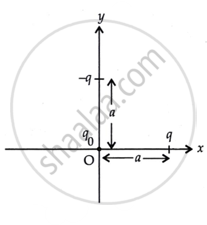
0
`(2kqq_0)/a^2`
`(sqrt 2 kqq_0)/a^2`
`1/sqrt 2 (kqq_0)/a^2`
Chapter:
A + 3.0 nC charge Q is initially at rest at a distance of r1 = 10 cm from a +5.0 nC charge q fixed at the origin. The charge Q is moved away from q to a new position at r2 = 15 cm. In this process work done by the field is ______.
1.29 × 10⁻⁵ J
3.6 × 10⁵ J
−4.5 × 10⁻⁷ J
4.5 × 10⁻⁷ J
Chapter:
A car battery is charged by a 12 V supply, and energy stored in it is 7.20 × 10⁵ J. The charge passed through the battery is ______.
6.0 × 10⁴ C
5.8 × 10³ J
8.64 × 10⁶ J
1.6 × 10⁵ C
Chapter:
A straight conducting rod of length l and mass m is suspended in a horizontal plane by a pair of flexible strings in a magnetic field of magnitude B. To remove the tension in the supporting strings, the magnitude of the current in the wire is ______.
`(mgB)/l`
`(mgl)/B`
`(mg)/(lB)`
`(lB)/(mg)`
Chapter:
A constant current is flowing through a solenoid. An iron rod is inserted in the solenoid along its axis. Which of the following quantities will not increase?
The magnetic field at the centre
The magnetic flux linked with the solenoid
The rate of heating
The self-inductance of the solenoid
Chapter:
A circuit is connected to an ac source of variable frequency. As the frequency of the source is increased, the current first increases and then decreases. Which of the following combinations of elements is likely to comprise the circuit?
L, C and R
L and C
L and R
R and C
Chapter:
If n, e, τ and m have their usual meanings, then the resistance of a wire of length l and cross-sectional area A is given by ______.
`("ne"^2A)/(2mtaul)`
`(ml)/("ne"^2tauA)`
`(mtauA)/("ne"^2l`
`("ne"^2tauA)/(2ml)`
Chapter:
A proton and an alpha particle move in circular orbits in a uniform magnetic field. Their speeds are in the ratio of 9 : 4. The ratio of radii of their circular orbits `(r_p/r_alpha)` is ______.
`3/4`
`4/3`
`8/9`
`9/8`
Chapter:
A coil of area 100 cm2 is kept at an angle of 30° with a magnetic field of 10−1 T. The magnetic field is reduced to zero in 10−4 s. The induced emf in the coil is ______.
`5sqrt3 V`
`50 sqrt3 V`
5.0 V
50.0 V
Chapter:
A 15 Ω resistor, an 80 mH inductor and a capacitor of capacitance C are connected in series with a 50 Hz ac source. If the source voltage and current in the circuit are in phase, then the value of capacitance is ______
100 μF
127 μF
142 μF
160 μF
Chapter:
Advertisements
Four objects W, X, Y and Z, each with charge +q are held fixed at four points of a square of side d as shown in the figure. Objects X and Z are on the midpoints of the sides of the square. The electrostatic force exerted by object W on object X is F. Then the magnitude of the force exerted by object W on Z is ______.

`F/7`
`F/5`
`F/3`
`F/2`
Chapter:
Two sources of equal emf are connected in series. This combination is, in turn connected to an external resistance R. The internal resistance of two sources are r1 and r2 (r2 > r1). If the potential difference across the source of internal resistance r2 is zero, then R equals to:
`(r_1 + r_2)/(r_2 - r_1)`
r2 − r1
`(r_1r_2)/(r_2 - r_1)`
`(r_1 + r_2)/(r_1r_2)`
Chapter:
Which of the following statements is correct?
Magnetic field lines do not form closed loops.
Magnetic field lines start from north pole and end at south pole of a magnet.
The tangent at a point on a magnetic field line represents the direction of the magnetic field at that point.
Two magnetic field lines may intersect each other.
Chapter:
The equivalent resistance between A and B of the network shown in figure is ______.
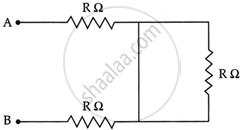
3R Ω
`(3/2)`R Ω
2R Ω
`(2/3)`R Ω
Chapter:
A bar magnet has magnetic dipole moment `barM`. Its initial position is parallel to the direction of uniform magnetic field `barB`. In this position, the magnitudes of torque and force acting on it respectively are ______.
0 and MB
MB and MB
0 and 0
`|barM xx barB|` and 0
Chapter:
Two charges 14 µC and −4 µC are placed at (−12 cm, 0, 0) and (12 cm, 0, 0) in an external electric field `E = (B/r^2)`, where B = 1.2 × 10⁶ N/(cm2) and r is in metres. The electrostatic potential energy of the configuration is ______.
97.9 J
102.1 J
2.1 J
−97.9 J
Chapter:
A 300 Ω resistor and a capacitor of `(25/pi)`µF are connected in series to a 200 V − 50 Hz ac source. The current in the circuit is ______.
0.1 A
0.4 A
0.6 A
0.8 A
Chapter:
The core of a transformer is laminated to reduce the effect of ______.
flux leakage
copper loss
hysteresis loss
eddy current
Chapter:
Assertion (A): A negative charge in an electric field moves along the direction of the electric field.
Reason (R): On a negative charge a force acts in the direction of the electric field.
Both (A) and (R) are true, and (R) is correct explanation of (A).
Both (A) and (R) are true, and (R) is not correct explanation of (A).
(A) is true, but (R) is false.
(A) is false and (R) is also false.
Chapter:
Assertion (A): The poles of a bar magnet cannot be separated.
Reason (R): Magnetic monopoles do not exist.
Both (A) and (R) are true, and (R) is correct explanation of (A).
Both (A) and (R) are true, and (R) is not correct explanation of (A).
(A) is true, but (R) is false.
(A) is false and (R) is also false.
Chapter:
Assertion (A): When radius of a current carrying loop is doubled, its magnetic moment becomes four times.
Reason (R): The magnetic moment of a current carrying loop is directly proportional to the area of the loop.
Both (A) and (R) are true, and (R) is correct explanation of (A).
Both (A) and (R) are true, and (R) is not correct explanation of (A).
(A) is true, but (R) is false.
(A) is false and (R) is also false.
Chapter:
Assertion (A): Higher the range, lower is the resistance of an ammeter.
Reason (R): To increase the range of an ammeter additional shunt is added in series to it.
Both (A) and (R) are true, and (R) is correct explanation of (A).
Both (A) and (R) are true, and (R) is not correct explanation of (A).
(A) is true, but (R) is false.
(A) is false and (R) is also false.
Chapter:
Assertion (A): A step-up transformer cannot be used as a step-down transformer.
Reason (R): A transformer works only in one direction.
Both (A) and (R) are true, and (R) is correct explanation of (A).
Both (A) and (R) are true, and (R) is not correct explanation of (A).
(A) is true, but (R) is false.
(A) is false and (R) is also false.
Chapter:
Equipotentials at a large distance from a collection of charges whose total sum is not zero are ______.
spheres
planes
ellipsoids
paraboloids
Chapter:
Four charges −q, −q, +q and +q are placed at the corners of a square of side 2 L is shown in figure. The electric potential at point A midway between the two charges +q and +q is:
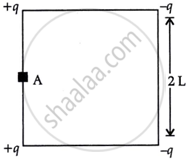
`1/(4 pi epsilon_0) (2q)/L(1 - 1/sqrt5)`
`1/(4 pi epsilon_0) (2q)/L(1 + 1/sqrt5)`
`1/(4 pi epsilon_0) q/(2L)(1 - 1/sqrt5)`
zero
Chapter:
An experiment was set up with the circuit diagram shown in figure.
Given that R1 = 10 Ω, R2 = R3 = 5 Ω, r = 0 Ω and E = 5 V.

The points with the same potential are ______.
b, c, d
f, h, j
d, e, f
a, b, j
Chapter:
An experiment was set up with the circuit diagram shown in figure.
Given that R1 = 10 Ω, R2 = R3 = 5 Ω, r = 0 Ω and E = 5 V.
The current through branch bg is ______.
1 A
`1/3 A`
`1/2 A`
`2/3 A`
Chapter:
An experiment was set up with the circuit diagram shown in figure.
Given that R1 = 10 Ω, R2 = R3 = 5 Ω, r = 0 Ω and E = 5 V.
The power dissipated in R1 is ______.
2 W
2.5 W
3 W
4.5 W
Chapter:
An experiment was set up with the circuit diagram shown in figure.
Given that R1 = 10 Ω, R2 = R3 = 5 Ω, r = 0 Ω and E = 5 V.
The potential difference across R3 is ______.
1.5 V
2 V
2.5 V
3 V
Chapter:
Other Solutions
Submit Question Paper
Help us maintain new question papers on Shaalaa.com, so we can continue to help studentsonly jpg, png and pdf files
CBSE previous year question papers Class 12 Physics with solutions 2021 - 2022
Previous year Question paper for CBSE Class 12 Physics-2022 is solved by experts. Solved question papers gives you the chance to check yourself after your mock test.
By referring the question paper Solutions for Physics, you can scale your preparation level and work on your weak areas. It will also help the candidates in developing the time-management skills. Practice makes perfect, and there is no better way to practice than to attempt previous year question paper solutions of CBSE Class 12.
How CBSE Class 12 Question Paper solutions Help Students ?
• Question paper solutions for Physics will helps students to prepare for exam.
• Question paper with answer will boost students confidence in exam time and also give you an idea About the important questions and topics to be prepared for the board exam.
• For finding solution of question papers no need to refer so multiple sources like textbook or guides.
