Commerce (English Medium)
Science (English Medium)
Arts (English Medium)
Academic Year: 2019-2020
Date & Time: 3rd March 2020, 10:30 am
Duration: 3h
Advertisements
General Instructions:
Read the following instructions very carefully and strictly follow them:
- This question paper comprises five sections - A, B, C, D and E. All questions are compulsory.
- Section A - Q. no. 1 to 20 are very short-answer type questions carrying 1 mark each. They are required to be answered in one word or one sentence each.
- Section B - Q. no. 21 to 24 are short-answer type questions carrying 3 marks each. Answer to each of them should not exceed 100 words.
- Section C - Q. no. 25 to 27 are long-answer type questions carrying 8 marks each. Answer to each of them should not exceed 350 words.
- Section D - Q. no. 28 to 30 are source based questions carrying 6 marks each.
- Section E - Q. no. 31 is a map question that includes identification and location of significant test items. Attach the map with the answer-book.
- Answer should be brief and to the point also the above word limit be adhered to as far as possible.
- There is no overall choice. However, an internal choice has been provided in two questions of one mark, one question of three marks, three questions of eight marks and map question. You have to attempt only one of the choices in such questions.
- In addition to this, separate instructions are given with each section and question, wherever necessary.
Name the author of the book “The Story of Indian Archaeology”.
Chapter:
Which of the following statement(s) is/are correct about the subsistence strategies of Harappa?
- Archeologists have reconstructed dietary practices from finds of charred, grains and seeds.
- Archaeo- botanists have studied grains found at Harappa like millets, barley, etc.
- Animals were domesticated according to archeobotanists.
(1) and (2) only
(2) and (3) only
(1), (2) and (3)
(2) only
Chapter:
Look at the figure given below and name it as given by the archeologists.
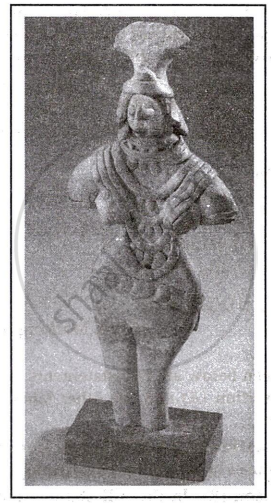
Chapter:
Why is Harappan script called enigmatic? Identify the appropriate reason from the following options:
It was pictograph and uniform.
It was written from left to right.
Scholars are not able to read the script.
It shows common feature of writing.
Chapter:
Where was the capital of Magadh shifted in the fourth century B.C.E.?
Chapter:
Name the most powerful Mahajanpada of Mauryan Empire between the sixth and fourth centuries B.C.E.
Chapter:
Read the following information and relate the context in which these messages were framed and spread by Ashoka in the third century B.C.E.
|
“The principles were simple and universal. Principles ensured well being of people. Ashoka tried to hold his empire together with these principles.” |
Chapter:
Correct the following statement and rewrite it:
Al-Biruni was from Tangier and written Ute Kitab-ul-Hind in Arabic language.
Chapter:
Muhammad Bin Tughlaq was impressed by the scholarship of Ibn Juzayy and appointed him as the Qazi of Delhi.
Chapter:
Match the following:
| List-I | List-II | ||
| (i) | Manucci | (a) | Samarqand |
| (ii) | Jean Baptist Tavernier | (b) | Italy |
| (iii) | Duarte Barbosa | (c) | France |
| (iv) | Abdur Razzak | (d) | Portuguese |
(i) - (b), (ii) - (c), (iii) - (d), (iv) - (a)
(i) - (a), (ii) - (d), (iii) - (c), (iv) - (b)
(i) - (d), (ii) - (a), (iii) - (b), (iv) - (c)
(i) - (c), (ii) - (b), (iii) - (a), (iv) - (d)
Chapter:
Ibn Battuta found Indian cities full of exciting opportunities. Identify the appropriate reason from the following options:
Large population, Bazaars and efficient communication.
Crown ownership of land.
Autonomous and equilitarian village command.
Traders exported gold and silver.
Chapter:
Advertisements
Who among the following developed the concept of the Asiatic mode of production?
Karl Marx
Montesquie
Voltaire
Rousseau
Chapter:
Name the major anthological composition of the Alvars which is described as the Tamil Veda.
Chapter:
Verses of Kabir are compiled in the Kabir Bijak, the Kabir Granthawali and ______.
Chapter:
Study the following flow chart and find out the name of the Land Revenue System introduced by the British in India.

Chapter:
Identify the economist whose ideas were operated by the British officials in Maharashtra in 1820’s.
David Ricardo
Thames Robert
John Stuart Mill
Walter Bagehot
Chapter:
The European commercial companies had set up base in different places of India. Find out the correct pair from the following information:
- The Portuguese in Panaji in 1510.
- The Dutch in Masulipatnam in 1605.
- The French in Pondicherry (Puducherry) in 1673.
(1) only
(1) and (2) only
(1), (2) and (3)
(2) and (3) only
Chapter:
Assertion (A): Hill stations were a distinctive features of colonial urban development.
Reason (R): In the hill stations the British and other Europeans sought to recreate settlements that were reminiscent of home.
Both (A) and (R) are correct and (R) is the correct explanation of (A).
Both (A) and (R) are correct, but (R) is not the correct explanation of (A).
(A) is correct, but (R) is not correct.
(R) is correct, but (A) is not correct.
Chapter:
Who among the following Governor Generals had done the town planning of Calcutta in his tenure?
Lord Wellesley
Lord Warren Hasting
Lord Minto-I
Lord Cornwallis
Chapter:
“There are limits to what epigraphy can reveal”. Justify the statement with suitable arguments.
Chapter:
“From the sixth century BCE land and Riverine routes criss-crossed the Indian sub-continent”. Substantiate the statement in the context of trade.
Chapter:
Advertisements
Describe the main features of Mahanavami Dibba of Vijaynagar Empire.
Chapter:
“Admist the partition of India, Gandhiji showed his conviction for communal harmony”. Explain the statement with examples.
Chapter:
Why did the British annex Awadh in 1856? On what pretext did they carry out act of annexation? Explain.
Chapter:
Explain how the Sanchi Stupa stands testimony to successful conservation policies taken up in the 19th century. Why did this not happen in the case of the Stupa at Amaravati? Explain.
Chapter:
“To understand the meanings of sculptures, historians have to be familiar with the stories behind them”. Support the statement by giving examples from Buddhist Art from 600 BCE to 600 CE.
Chapter:
“To understand the meanings of sculptures, historians have to be familiar with the stories behind them”. Support the statement by giving examples from Hindu Art from 600 BCE to 600 CE.
Chapter:
Describe the physical arrangements of the Mughal Court as the heart of society.
Chapter:
Examine the role of Congress party in making of the Constituent Assembly.
Chapter:
“Different groups expressed their desires in different ways and made different demands.” Support the statement with reference to the problem of separate electorate.
Chapter:
Read the following source carefully and answer the questions that follow:
|
The Wealthy Shudra This story, based on a Buddhist text in Pali known as the Majjhima Nikaya, is part of a dialogue between a king named Avantiputta and a disciple of the Buddha named Kachohana. While it may not be literally true, it reveals Buddhist attitudes towards varna. Avantiputta asked Kachchana what he thought about Brahmanas who held that they were the best caste and that all other castes were low; that Brahmanas were a fair caste while all other castes were dark; that only Brahmanas were pure, not non-Brahmanas; that Brahmanas were sons of Brahma, born of his mouth, born of Brahma, formed by Brahma, heirs to Brahma. Kachchana replied: “What if a Shudra were wealthy ... would another Shudra ... or a Kshatriya or a Brahmana or a Vaishya ... speak politely to him?” Avantiputta replied that if a Shudra had wealth or corn or gold or silver, he could have as his obedient servant another Shudra to get up earlier than he, to go to rest later, to carry out his orders, to speak politely; or he could even have a Kshatriya or a Brahmana or a Vaishya as his obedient servant. Kachchana asked: “This being so, are not these four varnas exactly the same?” Avantiputta conceded that there was no difference amongst the varnas on this count. |
- Why did the Brahmana consider themselves superior to other caste? 2
- How could a Shudra improve his status according to Kachchana? 2
- What does this story reveal about Buddhist attitude towards Varna? 2
Chapter:
Read the following source carefully and answer the questions that follow:
|
How Silver Came to India This excerpt from Giovanni Careri’s account (based on Bernier’s account) gives an idea of the enormous amount of wealth that found its way into the Mughal Empire: That the Reader may form some idea of the Wealth of this (Mughal) Empire, he is to observe that all the Gold and Silver which circulates throughout the World at last Centres here. It is well known that as much of it comes out of America, after running through several Kingdoms of Europe, goes partly into Turky (Turkey), for several sort of Commodities; and part into Persia, by the way of Smirna for Silk. Now the Turks not being able to abstain from Coffee, which comes from Hyeman (Oman), and Arabia ... nor Persia, Arabia, and the Turks themselves to go without the commodities of India, send vast quantities of Mony (money) to Moka (Mocha) on the Red Sea, near Babel Mandel; to Bassora (Basra) at the bottom of the Persian Gulgh (Gulf).... which is afterwards sent over in Ships to Indostan (Hindustan). Besides the Indian, Dutch, English, and Portuguese Ships, that every Year carry the Commodities of Indostan, to Pegu, Tanasserri (parts of Myanmar), Siam (Thailand), Ceylon (Sri Lanka) .... the Maldives Islands, Mozambique and other Places, must of necessity convey much Gold and Silver thither, from those Countries. All that the Dutch fetch from the Mines in Japan, sooner or later, goes to Indostan; and the goods carry’d hence into Europe, whether to France, England, or Portugal, are all purchas’d for ready Mony, which remains there. |
- How could the Mughal Empire accumulate enormous wealth? Explain. 2
- How did Silver travel to across the globe to reach India? Explain. 2
- How were the transactions made in the seventeenth century India?Explain. 2
Chapter:
Read the following source carefully and answer the questions that follow:
|
“Tomorrow we shall break the salt tax law” On 5 April 1930, Mahatma Gandhi spoke at Dandi: When I left Sabarmati with my companions for this seaside hamlet of Dandi, I was not certain in my mind that we would be allowed to reach this place. Even while I was at Sabarmati there was a rumour that I might be arrested. I had thought that the Government might perhaps let my party come as far as Dandi, but not me certainly. If someone says that this betrays imperfect faith on my part, I shall not deny the charge. That I have reached here is in no small measure due to the power of peace and non-violence: that power is universally felt. The Government may, if it wishes, congratulate itself on acting as it has done, for it could have arrested every one of us. In saying that it did not have the courage to arrest this army of peace, we praise it. It felt ashamed to arrest such an army. He is a civilized man who feels ashamed to do anything which his neighbours would disapprove. The Government deserves to be congratulated on not arresting us, even if it desisted only from fear of world opinion. Tomorrow we shall break the salt tax law. Whether the Government will tolerate that is a different question. It may not tolerate it, but it deserves congratulations on the patience and for bearance it has displayed in regard to this party.... What if I and all the eminent leaders in Gujarat and in the rest of the country are arrested? This movement is based on the faith that when a whole nation is roused and on the march no leader is necessary. |
- Examine the reactions of Indians towards the Salt Law. 2
- Why was Gandhiji confident that the government would not arrest the Satyagrahis? Explain. 2
- Examine the base of Dandi March. 2
Chapter:
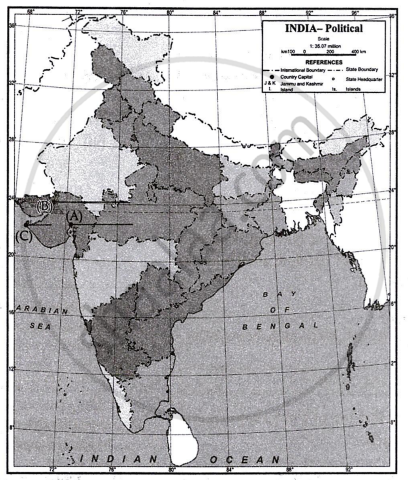
- On the given Political outline map of India locate and label any three from the following with appropriate symbols:
- Amritsar-an important centre of National Movement.
- Chauri-Chaura-The place where Gandhiji called off Non-Cooperation Movement.
- Vijaynagara-City ruled by Tuluva dynasty.
- Agra
- Gwalior-a centre of the Revolt of 1857.
- On the same outline map, three places related with Matured Harappan sites have been marked as A, B and C. Identify them and write their correct names on the lines marked near them.
Chapter:
Other Solutions
Submit Question Paper
Help us maintain new question papers on Shaalaa.com, so we can continue to help studentsonly jpg, png and pdf files
CBSE previous year question papers Class 12 History with solutions 2019 - 2020
Previous year Question paper for CBSE Class 12 History-2020 is solved by experts. Solved question papers gives you the chance to check yourself after your mock test.
By referring the question paper Solutions for History, you can scale your preparation level and work on your weak areas. It will also help the candidates in developing the time-management skills. Practice makes perfect, and there is no better way to practice than to attempt previous year question paper solutions of CBSE Class 12.
How CBSE Class 12 Question Paper solutions Help Students ?
• Question paper solutions for History will helps students to prepare for exam.
• Question paper with answer will boost students confidence in exam time and also give you an idea About the important questions and topics to be prepared for the board exam.
• For finding solution of question papers no need to refer so multiple sources like textbook or guides.
