Commerce (English Medium)
Science (English Medium)
Arts (English Medium)
Academic Year: 2025-2026
Date & Time: 26th February 2026, 10:30 am
Duration: 3h
Advertisements
General Instructions:
Read the following instructions carefully and follow them:
- This question paper contains 30 questions. All questions are compulsory.
- Question paper is divided into five Sections - Section A, B, C, D and E.
- Section A - Question Nos. 1 to 17 are Multiple Choice (MCQ) type questions. Each question carries 1 mark.
- Section B - Question Nos. 18 and 19 are source based questions. Each question carries 3 marks.
- Section C - Question Nos. 20 to 23 are Short Answer (SA) type questions. Each question carries 3 marks. Answer to these questions shall be written in 80 to 100 words.
- Section D - Question Nos. 24 to 28 are Long Answer (LA) type questions. Each question carries 5 marks. Answer to these questions shall be written in 120 to 150 words.
- Section E - Question Nos. 29 & 30 are Map based questions. Each question carries 5 marks.
- In addition to this, NOTE that a separate question has been provided for Visually Impaired Candidates in lieu of questions having visual inputs, map etc. Such questions are to be attempted by Visually Impaired Candidates only.
- There is no overall choice given in the question paper. However, an internal choice has been provided in a few questions.
Which one of the following cities serve as headquarter of two railway zones?
Kolkata
Chennai
Jaipur
Bilaspur
Chapter:
Choose the right group of states where Dravadian language is spoken majorly.
Tamil Nadu, Kerala and Maharashtra
Karnataka, Maharashtra and Andhra Pradesh
Tamil Nadu, Kerala and Karnataka
Andhra Pradesh, Telangana and Madhya Pradesh
Chapter:
In which one of the following countries, the ‘slash and burn cultivation’ is known as ‘Milpa’?
Mexico
Malaysia
Indonesia
India
Chapter:
Choose the correct option related to ‘entrepot port’:
Memphis, Copenhagen, Tripoli
Memphis, Singapore, Manchester
Rotterdam, Copenhagen, Singapore
Rotterdam, Tripoli, Manchester
Chapter:
Which of the following statements related to the concept of ‘development’ are correct? Choose the appropriate option.
- Development means positive change in life.
- When positive growth is there, it is development.
- When quantity is greater, it is development.
- Development is always relative to value.
Only I, II and III are correct.
Only I, II and IV are correct.
Only I, III and IV are correct.
Only II, III and IV are correct.
Chapter:
Match column - I with column - II correctly and choose the appropriate option:
| Column - I (Approach) |
Column - II (Characteristics) |
| a. Income Approach | i. Proposed by International Labour Organisation |
| b. Welfare Approach | ii. Health, education and access to resources – key factors |
| c. Basic Needs Approach | iii. It is one of the oldest approach |
| d. Capability Approach | iv. Human being – targeted beneficiaries |
a - ii, b - i, c - iv, d - iii
a - ii, b - i, c - iii, d - iv
a - iii, b - iv, c - ii, d - i
a - iii, b - iv, c - i, d - ii
Chapter:
Choose the correctly matched pair from the following:
Red collar worker - Civil servants
Gold collar worker - Environmental consultants
Pink collar worker - Electricians
White collar worker - Nurses
Chapter:
The loudness of the sound is measured in the unit known as ______.
Millimeter
Centimeter
Decimal
Decibel
Chapter:
Which one of the following is a natural process of land degradation?
Mining activities
Gully erosion
Industrial waste
Shifting cultivation
Chapter:
Which one of the following phases is associated with gradual slowing down of population growth in India?
Phase I
Phase II
Phase III
Phase IV
Chapter:
The ‘East-West Corridor’ connects which of the following set of cities?
Kandla to Silchar
Kandla to Shillong
Porbandar to Shillong
Porbandar to Silchar
Chapter:
Which one of the following statements is true regarding ‘medical tourism’ in India?
Tourists travel specially for availing cheap medical facilities.
Doctors travel to developed country to do surgical operation.
Doctors travel to treat the patients.
Tourists on trip get treated, if they fall ill.
Chapter:
Advertisements
Assertion (A): All the developed countries have opened their markets for products from developing countries.
Both (A) and (R) are true and (R) is the correct explanation of (A).
Both (A) and (R) are true but (R) is not the correct explanation of (A).
(A) is true but (R) is false.
(A) is false but (R) is true.
Chapter:
Read the following statements carefully regarding ‘tertiary activities’ and choose the correct option:
- Tertiary activities include both production and exchange of services.
- Tertiary activities involve the commercial output of services.
- Tertiary activities are directly involved in the processing of raw material.
- The examples of tertiary activities are - plumber, doctor, publisher.
Only I, II and III are correct.
Only I, II and IV are correct.
Only I, III and IV are correct.
Chapter:
Study the following table carefully and answer the question.
| Most populous countries | |||
| Sr. No. | Country | Population | % of world |
| 1 | India | 1,425,775,850 | 17.4 |
| 2 | China | 1,409,670,000 | 17.2 |
| 3 | United States of America | 337,975,234 | 4.13 |
| 4 | Indonesia | 278,696,200 | 3.41 |
| 5 | Pakistan | 229,488,994 | 2.80 |
| 6 | Nigeria | 216,746,934 | 2.65 |
| 7 | Brazil | 219,277,799 | 2.68 |
| 8 | Bangladesh | 168,220,000 | 2.06 |
| 9 | Mexico | 128,271,248 | 1.57 |
Which of the following set of continents is not represented in the table? Choose the most appropriate option.
Australia and Africa
Africa and South America
Europe and South America
Australia and Europe
Chapter:
Study the following table carefully and answer the question.
| Most populous countries | |||
| Sr. No. | Country | Population | % of world |
| 1 | India | 1,425,775,850 | 17.4 |
| 2 | China | 1,409,670,000 | 17.2 |
| 3 | United States of America | 337,975,234 | 4.13 |
| 4 | Indonesia | 278,696,200 | 3.41 |
| 5 | Pakistan | 229,488,994 | 2.80 |
| 6 | Nigeria | 216,746,934 | 2.65 |
| 7 | Brazil | 219,277,799 | 2.68 |
| 8 | Bangladesh | 168,220,000 | 2.06 |
| 9 | Mexico | 128,271,248 | 1.57 |
China and Brazil together account for what percentage of the world population?
17.88
17.58
19.88
19.58
Chapter:
Study the following table carefully and answer the question.
| Most populous countries | |||
| Sr. No. | Country | Population | % of world |
| 1 | India | 1,425,775,850 | 17.4 |
| 2 | China | 1,409,670,000 | 17.2 |
| 3 | United States of America | 337,975,234 | 4.13 |
| 4 | Indonesia | 278,696,200 | 3.41 |
| 5 | Pakistan | 229,488,994 | 2.80 |
| 6 | Nigeria | 216,746,934 | 2.65 |
| 7 | Brazil | 219,277,799 | 2.68 |
| 8 | Bangladesh | 168,220,000 | 2.06 |
| 9 | Mexico | 128,271,248 | 1.57 |
How many of the listed countries fall under Asian continent?
3
4
5
6
Chapter:
Study the map showing areas of ‘extensive commercial grains farming’ carefully and answer questions that follow:
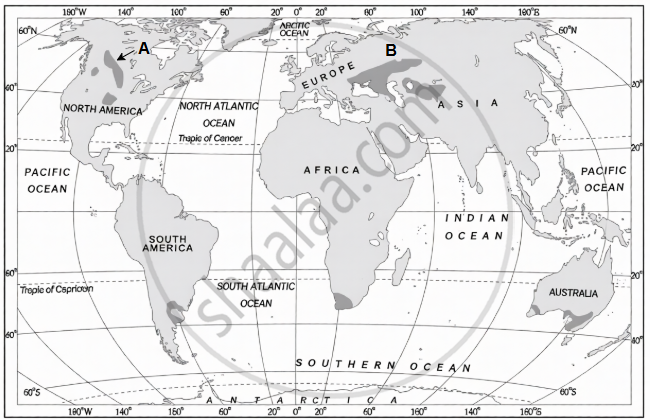
- Write the geographical name of the area marked as A. (1)
- Name any two major crops grown in region A. (1)
- Explain the agricultural importance of the area marked as B. (1)
Chapter:
Read the given passage carefully and answer the questions that follow:
|
Water Pollution Industries produce several undesirable products including industrial wastes, polluted waste water, poisonous gases, chemical residuals, numerous heavy metals, dust, smoke, etc. Most of the industrial wastes are disposed off in running water or lakes. Consequently, poisonous elements reach the reservoirs, rivers and other water bodies, which destroy the bio-system of these waters. Major water polluting industries are leather, pulp and paper, textiles and chemicals.
|
- Explain how industries are the major contributor of water pollution in India. (1)
- Suggest the way for minimising water pollution. (1)
- Mention two rivers of India which are highly polluted. (1)
Chapter:
Examine the relationships between ‘physical environment and human beings’.
Chapter:
Examine the importance of ‘productivity’ as a pillar of ‘human development’.
Chapter:
Study the following table carefully and answer the questions that follow:
| Sectoral composition of workforce in India, 2011 | ||||
| Categories | Populations | |||
| Persons | % to total workers |
Male | Female | |
| Primary | 26, 30, 22, 473 | 54.6 | 16, 54, 47, 075 | 9, 75, 75, 398 |
| Secondary | 1, 83, 36, 307 | 3.8 | 97, 75, 635 | 85, 60, 672 |
| Tertiary | 20, 03, 84, 531 | 41.6 | 15, 66, 43, 220 | 4, 37, 41, 311 |
- Why is the large difference between primary and tertiary categories of female workers? (1)
- Explain the reason of low variation between male workers of ‘primary’ and ‘tertiary’ sectors. (1)
- Why ‘secondary sector’ has low contribution in India’s workforce? (1)
Chapter:
Explain the main Characteristics of urban settlements in India.
Chapter:
Write a note on the evolution of towns in India.
Chapter:
Advertisements
“Manufacturing industries are classified on several bases.” Examine the main bases of classification in favour of the statement.
Chapter:
“Generally land-use in a region is influenced by the nature of economic activities.” Support the statement with suitable examples.
Chapter:
“The Indian agricultural problems have physical constraints and institutional hindrances.” Support the statement with suitable examples.
Chapter:
Explain the significance of petroleum as major source of energy.
Chapter:
Explain the significance of iron-ore as industrial raw material.
Chapter:
Describe the distribution of iron-ore in India.
Chapter:
“Railway is the mode of land transport for bulky goods and passengers over long distances.” In the context of this statement, explain the significance of railways in the world.
Chapter:
“Road transport is the most economical for short distances compared to railway.” In the context of this statement, explain the significance of road transport in the world.
Chapter:
Analyse the role of air transport in the ‘international trade’ of India.
Chapter:
Analyse the importance of water transport in the ‘international trade’ of India.
Chapter:
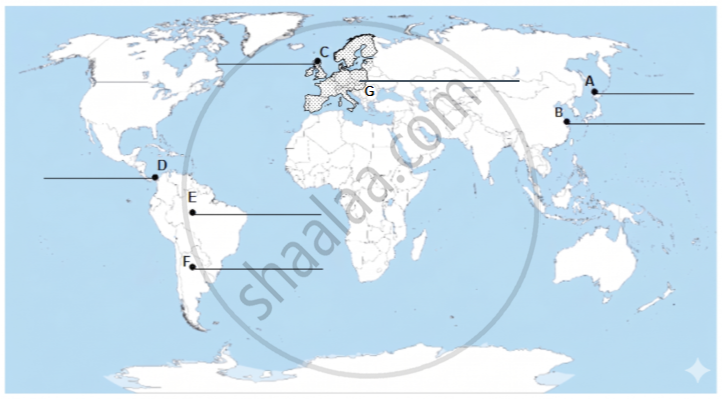
In the given political outline map of the world, seven geographical features have been marked as A, B, C, D, E, F and G. Identify any five of them with the help of following information and write their correct names on the lines drawn near them:
- A terminal station of the Trans-Siberian Railway
- A major sea port
- A major air port
- An international shipping canal
- An area of ‘subsistence gathering’
- An area of ‘commercial livestock rearing’
-
An area of ‘dairy farming’
Chapter:
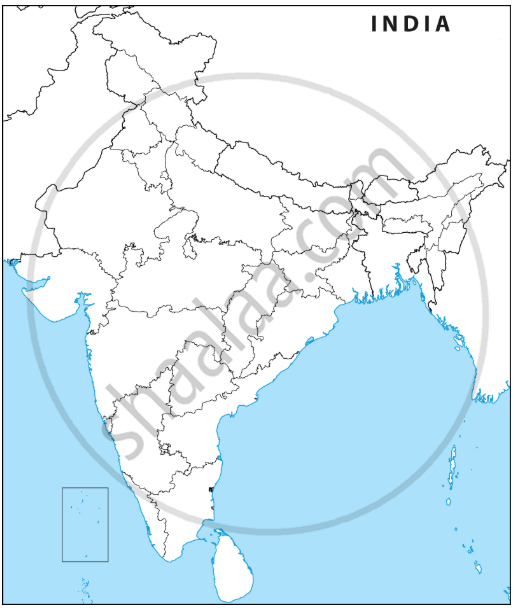
On the given political outline map of India, locate and label any five of the following seven geographical features with appropriate symbols:
- A state with the highest density of population (2011).
- A state leading in the production of tea.
- An iron-ore mining area in southern Chhattisgarh.
- A major area of bauxite mining in Odisha.
- An oil refinery in Uttar Pradesh.
- A major seaport located at the head of Gulf of Kuchchh.
- An international airport in Punjab.
Chapter:
Other Solutions
Submit Question Paper
Help us maintain new question papers on Shaalaa.com, so we can continue to help studentsonly jpg, png and pdf files
CBSE previous year question papers Class 12 Geography with solutions 2025 - 2026
Previous year Question paper for CBSE Class 12 Geography-2026 is solved by experts. Solved question papers gives you the chance to check yourself after your mock test.
By referring the question paper Solutions for Geography, you can scale your preparation level and work on your weak areas. It will also help the candidates in developing the time-management skills. Practice makes perfect, and there is no better way to practice than to attempt previous year question paper solutions of CBSE Class 12.
How CBSE Class 12 Question Paper solutions Help Students ?
• Question paper solutions for Geography will helps students to prepare for exam.
• Question paper with answer will boost students confidence in exam time and also give you an idea About the important questions and topics to be prepared for the board exam.
• For finding solution of question papers no need to refer so multiple sources like textbook or guides.
