Commerce (English Medium)
Science (English Medium)
Arts (English Medium)
Academic Year: 2024-2025
Date & Time: 24th February 2025, 10:30 am
Duration: 3h
Advertisements
General Instructions:
Read the following instructions carefully and follow them:
- This question paper contains 30 questions. All questions are compulsory.
- Question paper is divided into five Sections - Section A, B, C, D and E.
- Section A - Question Nos. 1 to 17 are Multiple Choice (MCQ) type questions. Each question carries 1 mark.
- Section B - Question Nos. 18 and 19 are Source based questions. Each question carries 3 marks.
- Section C - Question Nos. 20 to 23 are Short Answer (SA) type questions. Each question carries 3 marks. Answer to these questions shall be written in 80 to 100 words.
- Section D - Question Nos. 24 to 28 are Long Answer (LA) type questions. Each question carries 5 marks. Answer to these questions shall be written in 120 to 150 words.
- Section E - Question Nos. 29 & 30 are Map based questions. Each question carries 5 marks.
- In addition to this, NOTE that a separate question has been provided for Visually Impaired Candidates in lieu of questions having visual inputs, map etc. Such questions are to be attempted by Visually Impaired Candidates only.
- There is no overall choice given in the question paper. However, an internal choice has been provided in a few questions in all sections other than Section A.
The concept of ‘Neodeterminism’ was introduced by ______.
Ehrlich
C. Semple
Griffith Taylor
Humboldt
Chapter:
“Human geography is the synthetic study of relationship between human societies and earth’s surface.” This definition of human geography is given by ______.
Vidal-de-la-Blache
Richard Hartshorne
Ritter
Ratzel
Chapter:
Which one of the following is the core concern of geography as a discipline?
To understand population distribution and the factors affecting the same.
To understand the relationship between resource distribution and its utilization.
To understand the earth as the home of human beings and its sustainability.
To understand the earth as the home of natural resources and their estimation.
Chapter:
Read the following statements regarding inland ports carefully and choose the correct option:
- These ports are located away from the sea coast.
- These ports are linked to sea by inland water bodies.
- These ports are accessible by flat bottomed ships or barges.
- Kochchi, Aden and Honolulu are some of the examples of inland port.
Only (i), (ii) and (iii) are correct.
Only (i), (ii) and (iv) are correct.
Only (i), (iii) and (iv) are correct.
Only (ii), (iii) and (iv) are correct.
Chapter:
Assertion (A): ‘International trade may prove to be detrimental to nations’.
Reason (R): ‘It may lead to dependence on other nations causing exploitation.’
Both (A) and (R) are correct and (R) is the correct explanation of (A).
Both (A) and (R) are correct, but (R) is not the correct explanation of (A).
(A) is correct, but (R) is incorrect.
(A) is incorrect but (R) is correct.
Chapter:
“In modern times, trade is the basis of the world’s economic organisation and is related to the ______ of nations”.
bilateral trade policy
multi-lateral trade policy
foreign trade policy
internal need policy
Chapter:
Arrange the following towns of India as per their historical evolution from the oldest to the newest order and choose the correct option.
- Chennai
- Gandhinagar
- Patna
- Lucknow
(iii), (iv), (ii), (i)
(iii), (iv), (i), (ii)
(iv), (iii), (i), (ii)
(iv), (iii), (ii), (i)
Chapter:
Read the following statements regarding urban settlements of India carefully and choose the correct options:
- All urban settlements are manufacturing centres.
- Urban settlements are generally compact and larger in size:
- They are engaged in a variety of nonagricultural activities.
- The urban settlements have direct relation with rural settlements.
Only (i), (ii) and (iv) are correct.
Only (i), (iii) and (iv) are correct.
Only (ii), (iii) and (iv) are correct.
Only (i), (ii) and (iii) are correct.
Chapter:
Assertion (A): ‘The agriculturally rich states of Punjab, Haryana and western Uttar Pradesh are facing the crisis of groundwater depletion.’
Reason (R): ‘More groundwater is utilised for irrigation than water- table recharge.’
Both (A) and (R) are correct and (R) is correct reason of (A).
Both (A) and (R) are correct, but (R) is not the correct reason of (A).
(A) is not correct, but (R) is correct.
(A) is correct, but (R) is not correct.
Chapter:
Read the following statements related to Indira Gandhi Canal Project carefully and choose the correct option:
- Indira Gandhi Canal project was conceived by Kanwar Sain in 1950 and it was launched in 1961.
- Introduction of canal irrigation has brought perceptible changes in the agricultural economy of the command area.
- Spread of canal irrigation has led to increase in cultivated area and crop intensity.
- Traditional crops of jowar, bajra has been replaced by rice and wheat ete.
(i), (ii) and (iv) only are correct.
(i), (ii) and (iii) only are correct.
(i), (iii) and (iv) only are correct.
(ii), (iii) and (iv) only are correct.
Chapter:
Read the following statements related to international trade of India carefully and choose the correct option:
- India has a long coastline surrounded by ocean from three sides.
- Indian coasts have large number of well-developed sea ports.
- Kandla port exports huge amount of iron-ore.
- The transportation cost by water is very cheap for voluminous items.
Only (i), (ii) and (iv) are correct.
Only (i), (ii) and (iii) are correct.
Only (i), (iii) and (iv) are correct.
Only (ii), (iii) and (iv) are correct.
Chapter:
Why is it that slums are the areas of residence with least choice? Choose the correct options:
- They have dilapidated houses with poor ventilation.
- The basic facilities like lights and toilets are difficult to get.
- Hygienic conditions and drinking water are improper.
- Better drainage facilities are available.
Only (i), (ii) and (iii) are correct.
Only (ii), (iii) and (iv) are correct.
Only (i), (iii) and (iv) are correct.
Only (i), (ii) and (iv) are correct.
Chapter:
Advertisements
The watershed management programme in Jhabua district of Madhya Pradesh is funded by which one of the following ministries?
Rural Development
Environment
Transport
Irrigation
Chapter:
Local names like Panna, Para, Pali, Nagla, Dhani etc. are examples of which of the following types of rural settlements in India?
Clustered settlement
Semi-clustered settlement
Hamleted settlement
Dispersed settlement
Chapter:
| Composition of India’s export: 2009-2017 | ||||
| Commodities | 2009-10 | 2010-11 | 2015-16 | 2016-17 |
| Agriculture and allied products | 10.0 | 9.9 | 12.6 | 12.3 |
| Ore and minerals | 4.9 | 4.0 | 1.6 | 1.9 |
| Manufactured goods | 67.4 | 68.0 | 72.9 | 73.6 |
| Crude and petroleum products | 16.2 | 16.8 | 11.9 | 11.7 |
| Other commodities | 1.5 | 1.2 | 1.1 | 0.5 |
Under which one of the following category of commodities, maximum decline in export is recorded from 2015-16 to 2016-17?
Agriculture and allied products
Ore and minerals
Crude and petroleum products
Other commodities
Chapter:
| Composition of India’s export: 2009-2017 | ||||
| Commodities | 2009-10 | 2010-11 | 2015-16 | 2016-17 |
| Agriculture and allied products | 10.0 | 9.9 | 12.6 | 12.3 |
| Ore and minerals | 4.9 | 4.0 | 1.6 | 1.9 |
| Manufactured goods | 67.4 | 68.0 | 72.9 | 73.6 |
| Crude and petroleum products | 16.2 | 16.8 | 11.9 | 11.7 |
| Other commodities | 1.5 | 1.2 | 1.1 | 0.5 |
Under which one of the following categories of commodities, the increase in export is observed from 2010-11 to 2016-17?
Agriculture and allied products
Ore and minerals
Crude and petroleum products
Other commodities
Chapter:
| Composition of India’s export: 2009-2017 | ||||
| Commodities | 2009-10 | 2010-11 | 2015-16 | 2016-17 |
| Agriculture and allied products | 10.0 | 9.9 | 12.6 | 12.3 |
| Ore and minerals | 4.9 | 4.0 | 1.6 | 1.9 |
| Manufactured goods | 67.4 | 68.0 | 72.9 | 73.6 |
| Crude and petroleum products | 16.2 | 16.8 | 11.9 | 11.7 |
| Other commodities | 1.5 | 1.2 | 1.1 | 0.5 |
Under which one of the following category of commodities, increase in export is continuously observed?
Agriculture and allied products
Ore and minerals
Manufactured goods
Other commodities
Chapter:
Read the passage carefully and answer the questions that follow:
|
Hunting and Food Gathering The earliest human beings depended on their immediate environment for their sustenance. They subsisted on: (a) animals which they hunted; and (b) the edible plants which they gathered from forests in the vicinity. Primitive societies depended on wild animals. People located in very cold and extremely hot climates survived on hunting. The people in the coastal areas still catch fish through fishing has experienced modernisation due to technological development. Many species, now have become extinct or endangered due to illegal hunting (poaching). The early hunters used primitive tools made of stones, twigs or arrows so the number of animals killed was limited. Gathering and hunting are the oldest economic activity known. These are carried out at different levels with different orientations. Gathering is practised in regions with harsh climatic conditions. It often involves primitive societies, who extract, both plants and animals to satisfy their needs for food, shelter and clothing. This type of activity requires a small amount of capital investment and operates at very low level of technology. The yield per person is very low and little or no surplus is produced. |
- Examine the impact of poaching on wild animals.
- Why was hunting of animals limited in early times? Explain.
- Why did early man depend upon his immediate natural environment? Explain.
Chapter:
| Composition of Total Cultivable Land | ||||
| Agricultural Land use Categories | As a percentage of Reporting Area | As a percentage of total Cultivable Land | ||
| 1950-51 | 2014-15 | 1950-51 | 2014-15 | |
| Culturable waste land | 8.0 | 4.0 | 13.4 | 6.8 |
| Fallow other than current fallow | 6.1 | 3.6 | 10.2 | 6.2 |
| Current fallow | 3.7 | 4.9 | 6.2 | 8.4 |
| Net area sown | 41.7 | 45.5 | 70.0 | 78.4 |
| Total Cultivable Land | 59.5 | 58.0 | 100.00 | 100.00 |
- Mention the reason for the decrease in cultivable waste land in 2014-15 as compared to 1950-51.
- Mention the reason for the increase in current fallow during 2014-15 as compared to 1950-51.
- Explain the reason of continuous increase in net area sown.
Chapter:
Study the map of Rhine waterways and answer the questions that follow:
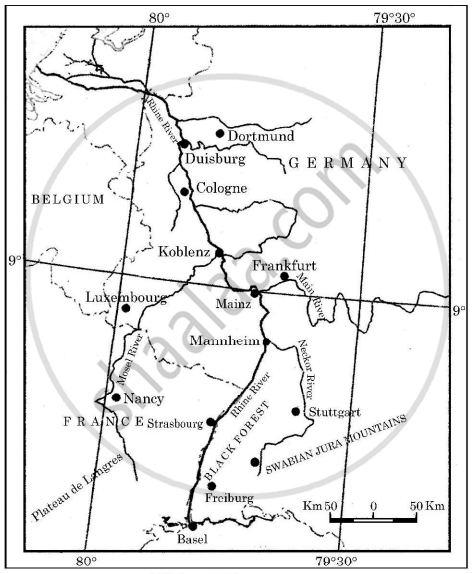
- Name the country in which most of Rhine river lies.
- Name two countries whose industrial areas are connected by river Rhine.
- Why is river Rhine world’s most heavily used waterway?
Chapter:
Examine the role of climate, water availability and soil fertility on the distribution of world population.
Chapter:
Examine three stages of demographic transition theory.
Chapter:
Explain the main features of State Highways in India.
Chapter:
Suggest the measures to solve the problems of urban waste disposal in India.
Chapter:
Advertisements
Explain the approach suggested by Amartya Sen to increase human development.
Chapter:
Examine the four major aspects of human development.
Chapter:
Assess the growth and significance of service sector in the development of the world economy.
Chapter:
Assess the growth and significance of transport and communication services in the world economy.
Chapter:
Analyse the rural-urban characteristics of Indian population.
Chapter:
Analyse the main features of the composition of working population in India.
Chapter:
Explain the main features of large scale manufacturing industries in the world.
Chapter:
Explain the main features of ‘High Tech’ industries in the world.
Chapter:
“Although India is richly endowed with a variety of mineral resources yet distribution of minerals over space is highly uneven.”Evaluate the statement.
Chapter:
“For the sustainable development there is urgent need for the conservation of mineral resources.” Evaluate the statement.
Chapter:
On the outline political map of the world, seven geographical features have been marked as A, B, C, D, E, F and G. Identify any FIVE of them and write their names on the lines drawn near them:
- Major sea port in Germany.
- Terminal station of Trans-Siberian Railway.
- An international airport.
- An area of subsistence gathering.
- An important waterway.
- An area of ‘Nomadic Herding’.
- An area of extensive commercial grain farming.
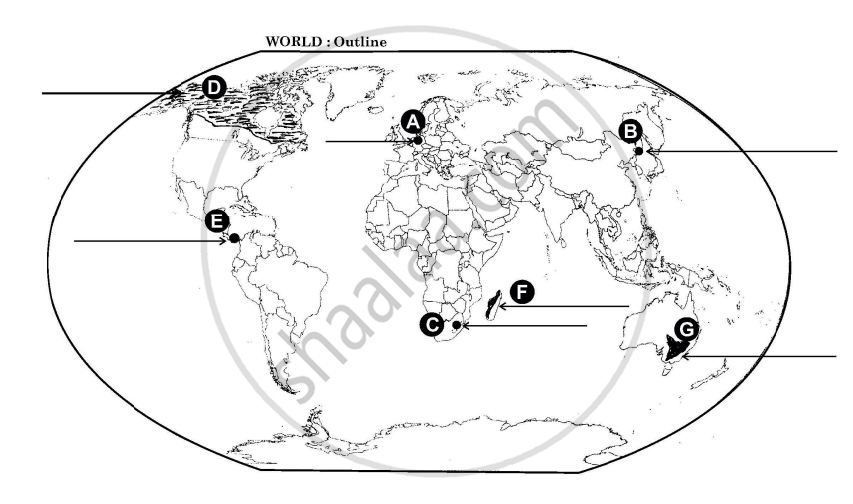
Chapter:
On the given political outline map of India, locate and label any five of the following geographical features with appropriate symbols.
- Important iron ore mines in Odisha.
- An important seaport in Kerala.
- A copper mine in Rajasthan.
- An oil refinery in Bihar.
- An international airport in Punjab.
- A state with highest density of population.
- A state leading in the production of jute.
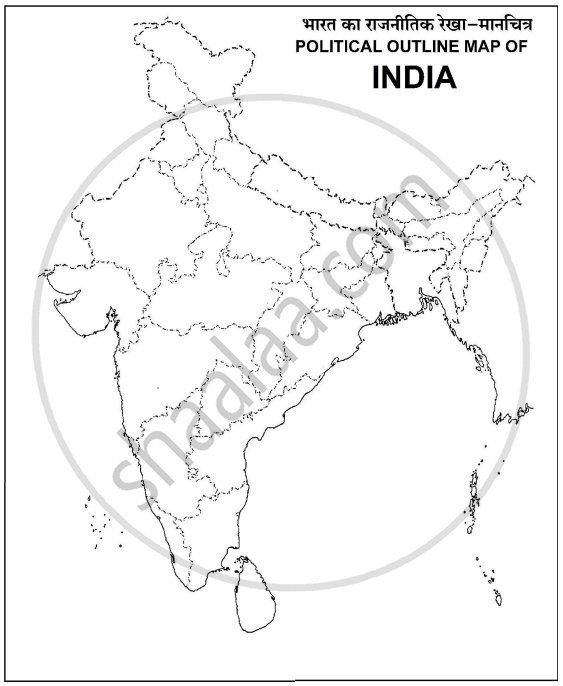
Chapter:
Other Solutions
Submit Question Paper
Help us maintain new question papers on Shaalaa.com, so we can continue to help studentsonly jpg, png and pdf files
CBSE previous year question papers Class 12 Geography with solutions 2024 - 2025
Previous year Question paper for CBSE Class 12 Geography-2025 is solved by experts. Solved question papers gives you the chance to check yourself after your mock test.
By referring the question paper Solutions for Geography, you can scale your preparation level and work on your weak areas. It will also help the candidates in developing the time-management skills. Practice makes perfect, and there is no better way to practice than to attempt previous year question paper solutions of CBSE Class 12.
How CBSE Class 12 Question Paper solutions Help Students ?
• Question paper solutions for Geography will helps students to prepare for exam.
• Question paper with answer will boost students confidence in exam time and also give you an idea About the important questions and topics to be prepared for the board exam.
• For finding solution of question papers no need to refer so multiple sources like textbook or guides.
