Advertisements
Advertisements
प्रश्न
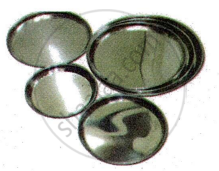
You may have seen your image formed on surfaces such as a new steel dish, the glossy granite cladding of a wall and the still water in a lake. Make a list of other similar surfaces. Compare the images seen in them. Make a guess about the property of a surface due to which an image is formed. Discuss this with your teachers and parents.
Advertisements
उत्तर
Besides a new steel dish, glossy granite and still water, we can see our image on several other smooth and shiny surfaces.
| Surface | Description of the image formed |
|---|---|
| Plane mirror | A plane mirror forms a very clear and distinct image because its surface is smooth and highly polished. |
| Polished stainless-steel plate | A polished stainless-steel plate forms a fairly clear image because its surface reflects light well. |
| Shiny metal spoon | A shiny metal spoon forms an image, but the image may appear curved, enlarged, reduced or distorted because the spoon has a curved surface. |
| Glass pane | A glass pane may form a faint image because some of the light falling on it is reflected. |
| Polished marble or glossy tiles | Polished marble or glossy tiles can form a faint or fairly clear image because their surfaces are smooth and shiny. |
| Still water in a vessel or pond | Still water can form a clear image because its smooth surface reflects light regularly. |
| Rough wall or wooden surface | A rough wall or an unpolished wooden surface does not form a clear image because its uneven surface scatters light in different directions. |
From these observations, we can conclude that smooth, even and shiny surfaces reflect light regularly and therefore form clearer images. Rough and uneven surfaces scatter the reflected light in different directions, so they do not form a clear image. The Balbharati textbook similarly notes that an image can be seen in a glass pane, though faintly, whereas no image is seen on a wooden surface.
