Advertisements
Advertisements
प्रश्न
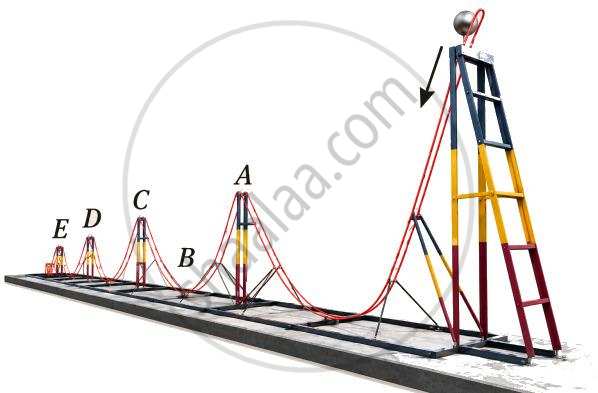
You may have seen an exhibit like that in the Fig. in a science park, where a ball is released from the highest point. Describe how the kinetic energy and potential energy change at points A, B and C. Why do subsequent points, such as C, D and E, usually have lower heights compared to the previous ones? Could it have anything to do with the energy lost due to friction?
Advertisements
उत्तर
From the highest point A, the ball is released.
The ball is at its highest point (A) and is briefly at rest. Thus, its kinetic energy is zero (minimum) and its potential energy is greatest.
At B (a lower point): The ball's height drops as it travels from A to B. As a result, kinetic energy rises while potential energy falls.
At C, which is below A and the next peak: Kinetic energy is transformed back into potential energy as the ball ascends to C once more. Thus, the potential energy rises while the kinetic energy falls. However, the potential energy at C is smaller than that at A since C is lower than A.
Because some mechanical energy is always lost in overcoming air resistance and friction and is primarily transformed into thermal and acoustic energy, the following locations, such as C, D, and E, often have lower heights than the previous ones. Therefore, the ball is unable to return to its initial height. Thus, it is true that the energy lost to friction is what causes the heights to decrease.
