Advertisements
Advertisements
प्रश्न
You are given three mirrors of different types. How will you identify each one of them?
Advertisements
उत्तर
We are given three different types of mirrors. To identify each one of them we will take an object and place it in different positions. Accordingly, we will get the positions of the image and nature of the image for each mirror, through which mirrors can be identified.
| Properties of the image formed | Plane mirror | Concave mirror | Convex mirror |
| Real or virtual | Virtual | Real except when the object is near the mirror | Virtual |
| Erector inverted | Always erect | Inverted when real and erect when virtual | Always erect |
| Size of image | Image formed is of the same size as the object | Diminished for certain positions and enlarged for others | Always diminished |
APPEARS IN
संबंधित प्रश्न
Which type of mirror is used in the following?
Periscope
Under what condition in an arrangement of two plane mirrors, incident ray and reflected ray will always be parallel to each other, whatever may be angle of incidence. Show the same with the help of diagram.
If an object is placed at a distance of 0.5 m in front of a plane mirror, the distance between the object and the image formed by the mirror will be
The inner surface of a steel spoon acts as a ______ mirror.
The outer surface of a flat steel plate acts as a ______ mirror.
The outer shining surface of a round bottom steel bowl acts as a ______ mirror.
The side mirror of a scooter got broken. The mechanic replaced it with a plane mirror. Mention any inconvenience that the driver of the scooter will face while using it?
An erect and enlarged image of an object is formed on a screen. Explain how this could be possible.
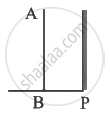
A person AB of height 170 cm is standing in front of a vertical plane mirror. His eyes are at height 164 cm from ground. At what distance from P should a hole be made in the mirror so that he cannot see the top of his head?
Which type of mirror is used in the following?
Kaleidoscope
