Advertisements
Advertisements
प्रश्न
X is a normally distributed variable with mean µ = 30 and standard deviation σ = 4. Find P(X > 21)
Advertisements
उत्तर
Given X ~ N(µ, σ2)
µ = 30
σ = 4
P(X > 21) = `"P"("Z" > (21 - 30)/4)`
= P(Z > – 2.25)
= 0.5 + P(– 2.25 < Z < 0)
= 0 5 + P(0 < Z < 2.25)
= 0.5 + 0.4878
= 0.9878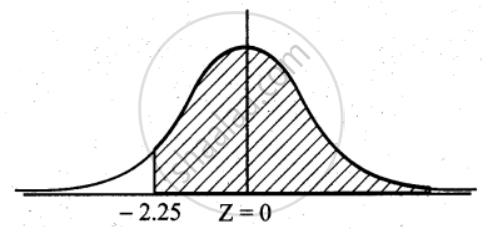
APPEARS IN
संबंधित प्रश्न
If the probability of success is 0.09, how many trials are needed to have a probability of atleast one success as 1/3 or more?
Forty percent of business travellers carry a laptop. In a sample of 15 business travelers, what is the probability that 12 of the travelers will not have a laptop?
The mean of a binomial distribution is 5 and standard deviation is 2. Determine the distribution
Determine the binomial distribution for which the mean is 4 and variance 3. Also find P(X=15)
An experiment succeeds twice as often as it fails, what is the probability that in next five trials there will be three successes
The average number of phone calls per minute into the switchboard of a company between 10.00 am and 2.30 pm is 2.5. Find the probability that during one particular minute there will be no phone at all
The average number of phone calls per minute into the switchboard of a company between 10.00 am and 2.30 pm is 2.5. Find the probability that during one particular minute there will be exactly 3 calls
Choose the correct alternative:
If X ~ N(µ, σ2), the maximum probability at the point of inflexion of normal distribution
Choose the correct alternative:
Monthly expenditure on their credit cards, by credit cardholders from a certain bank, follows a normal distribution with a mean of ₹ 1,295.00 and a standard deviation of ₹ 750.00. What proportion of credit cardholders spend more than ₹ 1,500.00 on their credit cards per month?
The birth weight of babies is Normally distributed with mean 3,500g and standard deviation 500g. What is the probability that a baby is born that weighs less than 3,100g?
