Advertisements
Advertisements
प्रश्न
Write whether the following statement vary directly, vary inversely with each other, or neither of the two.
The time taken by a train to cover a fixed distance and the speed of the train.
Advertisements
उत्तर
The time taken by a train to cover a fixed distance and the speed of the train are inversely proportional.
E.g. Let a train cover 100 km in 1 h with speed 100 km/h.
Then, the same train cover 100 km in 30 min with speed 200 km/h.
APPEARS IN
संबंधित प्रश्न
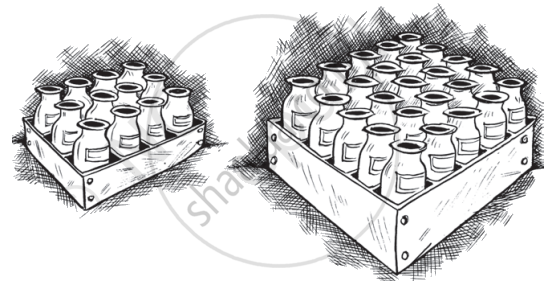
A batch of bottles was packed in 25 boxes with 12 bottles in each box. If the same batch is packed using 20 bottles in each box, how many boxes would be filled?
If 40 workers can do a project work in 8 days, then _________ workers can do it in 4 days
6 pumps are required to fill a water sump in 1 hr 30 minutes. What will be the time taken to fill the sump if one pump is switched off?
Which of the following vary inversely with each other?
Both x and y are said to vary ______ with each other if for some positive number k, xy = k.
If two quantities p and q vary inversely with each other then ______ of their corresponding values remains constant.
If x and y are in inverse proportion, then (x + 1) and (y + 1) are also in inverse proportion.
If one angle of a triangle is kept fixed then the measure of the remaining two angles vary inversely with each other.
Write whether the following statement vary directly, vary inversely with each other, or neither of the two.
Increase in cost and number of shirts that can be purchased if the budget remains the same.
Find the values of x and y if a and b are in inverse proportion:
- 12 x 8
- 30 5 y
