Advertisements
Advertisements
प्रश्न
Write the reactions involved when D-glucose is treated with the following reagent:
H2N-OH
Advertisements
उत्तर
\[\begin{array}{cc}
\phantom{............}\ce{CHO}\phantom{.............}\ce{CO=N-OH}\\
\phantom{..}|\phantom{..................}|\\
\phantom{........}\ce{(CHOH)4->[NH2OH](CHOH)4}\\
\phantom{..}|\phantom{..................}|\\
\phantom{.........}\ce{\underset{\text{D-glucose}}{CH2OH}}\phantom{..........}\ce{\underset{\text{Oxime}}{CH2OH}}
\end{array}\]
APPEARS IN
संबंधित प्रश्न
Draw the simple Fisher projection formulae of D - (+) - glucose and D - (-) - fructose
Enumerate the reactions of D-glucose which cannot be explained by its open chain structure.
Maltose is a
(a) Polysaccharide
(b) Disaccharide
(c) Trisaccharide
(d) Monosaccharide
Choose the appropriate answer(s) for the below representation from the options given

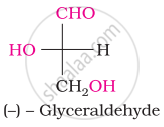
Acetylation of glucose yields ____________.
The reaction of glucose with red P + HI is called ____________.
The letter D and L in carbohydrates represent ____________.
In the following reaction, identify A and B:
\[\begin{array}{cc}
\ce{C6H12O6 ->[Acetic anhydride] A}\\
\downarrow \text{Conc. nitric acid}\phantom{...}\\
\ce{B}\phantom{.................}\end{array}\]
Three structures are given below in which two glucose units are linked. Which of these linkages between glucose units are between C1 and C4 and which linkages are between C1 and C6?
| (I) |  |
| (II) |  |
| (III) |  |
Give the reaction of glucose with hydrogen cyanide. Presence of which group is confirmed by this reaction?
