Advertisements
Advertisements
प्रश्न
Write the answers to the questions by observing the figure.
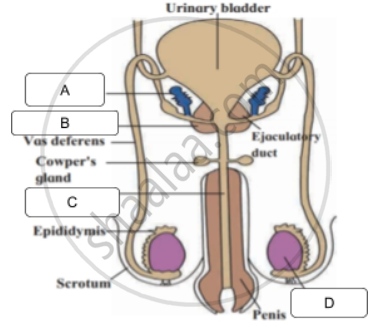
- What does the above figure show?
- Write the names of parts A, B, C, D.
- Write the function of the part 'D'.
- How is semen formed?
Advertisements
उत्तर
- The given figure represents the human male reproductive system.
- A: Seminal vesicle
B: Prostate gland
C: Urinogenital duct
D: Testis - The part labelled as ‘D’ is testis which is responsible for sperm production.
- Semen is formed of sperms and secretions of seminal glands, prostate gland and Cowper’s glands.
APPEARS IN
संबंधित प्रश्न
Write the location and function of the Sertoli cells in humans.
Write two major functions of testis.
Identify True/False statement. Correct false statement to make it true.
Spermatozoa get nutrition from Sertoli cells.
The external layer of connective tissue sheath of human testis is __________.
Differentiate between the Tubectomy and Vasectomy (Part cut and tied)
Fill in the blank:
The sac-like structure present outside the body and which contains testes is called _________.
Describe the male reproductive systems in humans.
Name the Following
Muscular extension of cauda epididymis.
Give Technical Term:
Name the male gamete of a mammal.
Complete the following sentences with appropriate word:
The surgical sterilization of males is known as _________.
Write the functions of penis
Identify the accessory sex gland consisting of 20-30 separate lobes and secreting about 30% of semen.
In the male reproductive system, the vasa deferens joins the ____________.
Each testis is connected to the wall of scrotum by short. fibromuscular band called ______.
During adolescence, several changes occur in the human body. Mark one change associated with sexual maturation in boys
The Leydig cells as found in the human, body are the secretory source of ______.
Vasa efferentia exist in between:
Explain the function of the following structure in the human male reproductive system.
Leydig cells
Given below is the outline of the male reproductive system. Name the parts labelled 1 to 8. Also name the corresponding structure of part (4) in female reproductive system.
 |
What percentage of total semen volume does the prostate gland contribute?
