Advertisements
Advertisements
प्रश्न
Write a short note on resonance.
Advertisements
उत्तर
The resonance is a chemical phenomenon that is observed in certain organic compounds possessing double bonds at a suitable position. Certain organic compounds can be represented by more than one structure and they differ only in the position of bonding and lone pair of electrons. Such structures are called resonance structures (canonical structures) and this phenomenon is called resonance. This phenomenon is also called mesomerism or mesomeric effect.
For example, the structure of aromatic compounds such as benzene and conjugated systems like 1,3 – butadiene cannot be represented by a single structure, and their, observed properties can be explained on the basis of a resonance hybrid.
In 1,3 butadiene, it is expected that the bond between C1 – C2 and C3 – C4 should be shorter than that of C2 – C3, but the observed bond lengths are of the same. This property cannot be explained by a simple structure in which two n bonds localized between C1 – C2 and C3 – C4. Actually, the n electrons are delocalized as shown below.

The resonating structures are called canonical forms and the actual structure lies between these three resonating structures, and is called a resonance hybrid. The resonance hybrid is represented as below.

Similar to the other electron displacement effect, mesomeric effect is also classified into positive mesomeric effect (+M or +R) and negative mesomeric effect (-M or -R) based on the nature of the functional group present adjacent to the multiple bonds.
APPEARS IN
संबंधित प्रश्न
For the following reactions
- \[\ce{CH3CH2CH2Br + KOH → CH3 – CH = CH2 + KBr + H2O}\]
- \[\ce{(CH3)3CBr + KOH → (CH3)3COH + KBr}\]
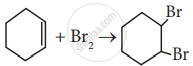
Which of the following statement is correct?
What is the hybridisation state of benzyl carbonium ion?
Which of the following species is not electrophilic in nature?
- I effect is shown by ______.
Assertion: Tertiary Carbocations are generally formed more easily than primary Carbocations ions.
Reason: Hyper conjucation as well as inductive effect due to additional alkyl group stabilize tertiary carbonium ions.
Heterolytic fission of C–C bond results in the formation of ______.
The geometrical shape of carbocation is ______.
Write a short note on hyperconjucation.
Show the heterolysis of a covalent bond by using curved arrow notation and complete the following equation. Identify the nucelophile.
CH3 – Br + KOH →
Show the heterolysis of a covalent bond by using curved arrow notation and complete the following equation. Identify the nucelophile.
\[\ce{CH3 – O – CH3 + HI →}\]
