Advertisements
Advertisements
प्रश्न
Write a short note on:
Population pyramid and sex ratio.
Advertisements
उत्तर
- The ratio between the number of males and females in the population is called the sex ratio.
- Sex ratio is an indicator of the status of women in the country.
- In the population pyramid the X-axis shows the percentage of the population in a particular age group and the Y-axis, which is at the center of the graph, shows age groups.
- The length of the bar shows a number or percentage.
- The left side of the graph shows the male population, whereas the right side shows the female population.
- Thus, the population pyramid indicates the percentages of the country's male and female population in different age groups.
e.g., If we want to know the percentage of males and females in the 15-59 age group, we can get it from the population pyramid. - Therefore, we can study the age-wise sex ratio using the population pyramid.
APPEARS IN
संबंधित प्रश्न
Why have many European countries have deficit males?
What do you mean by an aging population?
How is sex ratio calculated in different countries of the world?
Why is sex ratio in some European countries recorded favourable to females? Give one reason.
Which age group forms the working population?
“The shape of the population pyramid reflects the characteristics of the population.” Support the statement with examples.
Which state has the highest sex ratio?
The aging population has aged more than ______.
Study the given graph carefully and answer the following question:
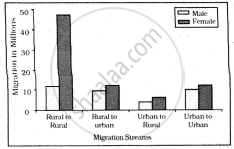
Intra-state Migration by place of Last Residence Indicating Migration Streams India, 2011
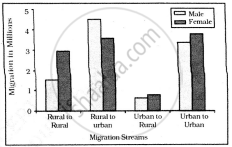
Inter-state Migration by Place of Last Residence Indicating Migration Streams India, 2011
Which stream of migration shows the lowest trend in interstate migration?
Sex ratio in the world is calculated as?
