Advertisements
Advertisements
प्रश्न
Write a paragraph and give an appropriate title to it. Use the following points.
| Birds and Animals | Love and Affection |
| Loyal | Our Best Friends |
| Serve us | Protection and Security |
| Kindness, honesty, compassion | Do not hurt or destroy us |
| Loneliness Avoided | |
Advertisements
उत्तर
Our Finest Friends: Birds and Animals
Birds and animals are as much a part of the ecosystem as human beings. They too have the right to enjoy nature’s gifts like us. As pets, they give us the love and affection we need to live a happy life. They are the source of comfort in times of distress. Their positive energy is hard to miss. For example, a dog devotes his life to serving his owner. He loves his owner unconditionally and strives to make his life better. His loyalty cannot be compared to anything else in the world. The happiness on his face when he sees his owner at the end of a long day is priceless. He becomes his owner’s best friend and builds his world around him. Animals are a joy to have as pets. They make our lives better in ways we can never imagine. They provide us with a sense of protection and security. They cheer us up and make us better individuals. Animals do not hurt us or threaten to destroy us. Therefore, it becomes our sole responsibility to be kind and compassionate towards animals.
We humans need to understand that a world without animals will not be worth living in. We will not just be lonely without them; we will in fact be lost.
APPEARS IN
संबंधित प्रश्न
If your friends get here before 7 o’clock we can take them out for dinner.
(Rewrite: Using ‘unless’)
The poet refers to a dying fire. Who were sitting beside it and why?
Comment on the contrasted viewpoints in the poem.
Define the following terms from the poem: rivulet, plough share (plowshare), yon, and childing.
Which line(s)/stanza(s) do you enjoy most? Why?
Write a composition (350 - 400 words) on the following:
Study the picture given below. Write a story or a description or an account of what it suggests to you. Your composition may be about the subject of the picture or you may take suggestions from it; however, there must be a clear connection between the picture and your composition.

Choose two of the passages (a) to (c) and answer briefly the questions that follow:
Raina :
Come away from the window (She takes him firmly back to the middle of the room. The moment she releases him he turns mechanically towards the window again. She seizes him and turns him back, exclaiming) Please! (He becomes motionless, like a hypnotized rabbit, his fatigue gaining fast on him. She releases him, and addresses him patronizingly). Now listen. You must trust to our hospitality. You do not yet know in whose house you are. I am a Petkoff.
The Man: A pet what?
Raina : [rather indignantly] I mean that I belong to the family of the Petkoffs, the richest and best known in our country.
The Man: Oh yes, of course. I beg your pardon. The Petkoffs, to be sure. How stupid of me!
Raina: You know you never heard of them until this moment. How can you stoop to pretend!
The Man: Forgive me. I'm too tired to think, and the change of subject was too much for me. Don't scold me.
(i) Why did the man keep turning to the window?
(ii) Which examples of the social superiority of the Petkoff's does Raina give the man?
(iii) Which opera does Raina mention? With whom does she compare herself? What does this tell you about her?
(iv) In Raina's opinion, what should the man have done instead of threatening her?
(v) What does the man tell Raina about his father? Why does he do so?
(vi) What does the man do at the end of the scene?
The soldier laid________their lives defending their country.
What could the narrator hear as he was lying down?
Read the following passage carefully and answer the questions that follow:
Lying in bed, Swami realized with a shudder that it was Monday morning. It looked as though only a moment ago, it had been the last period on Friday; already, Monday was here. He hoped that an earthquake would reduce the school building to dust but that my good building, Albert Mission School, had withstood similar prayers for over a hundred years now.
At nine o'clock, Swaminathan wailed, “I have a headache.”
His mother said, “Why don’t you go to school in a bullock cart?”
“So that I may be completely dead at the other end? Have you any idea what it means to be jolted in a cart?”
“Have you any important lessons today?”
“Important! Bah! That geography teacher has been teaching the same lesson for over a year now. And we have arithmetic, which means for a whole period we are going to be beaten by the teacher............ Important lessons!”
And Mother generously suggested that Swami might stay at home.
At 9:30, when he ought to have been lining up in the school prayer hall, Swami was lying on the bench in Mother’s room.
Father asked him, “Have you no school today?”
“Headache,” Swami replied,
“Nonsense! Dress up and go.”
“Headache.”
“Loaf about less on Sundays, and you will be without a headache on Monday.”
Swami knew how stubborn his father could be and changed his tactics.
“I can’t go so late to class.”
“I agree, but you’ll have to; it is your own fault. You should have asked me before deciding to stay away.”
“What will the teacher think if I go so late?”
“Tell him you had a headache, and so are late.”
“He will beat me if I say so.”
“Will he? Let us see. What is his name?”
“Mr. Samuel.”
“Does he beat the boys?”
“He is very violent, especially with boys who come late. Some days ago, a boy was made to stay on his knees for a whole period in a corner of the class because he came late, and after getting six cuts from the cane and having his ears twisted, I wouldn’t like to go late to Mr Samuel’s class.”
“If he is so violent, why not tell your headmaster about it?”
“They say that even the headmaster is afraid of him. He is such a violent man.”
And then Swami gave a lurid account of Samuel’s violence; how when he started caning, he would not stop till he saw blood on the boy’s hand, which he made the boy press to his forehead like a Vermillion marking. Swami hoped his father would be made to see that he couldn’t go to his class late. But his father’s behaviour took an unexpected turn. He became excited.
“What do these people mean by beating our children? They must be driven out of service. I will see…..”
The result was that he proposed to send Swami late to his class as a kind of challenge. He was also going to send a letter with Swami to the headmaster. No amount of protest from Swami was of any avail: Swami had to go to school.
By the time he was ready, his father had composed a long letter to the headmaster, put it in an envelope, and sealed it.
“What have you written, father?” Swaminathan asked apprehensively.
“Nothing for you. Give it to your headmaster and go to your class.”
Swami’s father did not know the truth—that, actually, Mr. Samuel was a very kind gentleman.
(a) Give the meaning of each of the following words as used in the passage. (3)
One-word answers or short phrases will be accepted.
- jolted
- stubborn
- avail
(b) Answer the following questions briefly in your own words:
- What did Swami wish for on a Monday morning? Why was his wish unlikely to be answered? (2)
- Which sentence tells us that Swami’s father was completely unsympathetic to his son’s headache? (2)
- In what way was Swami’s mother’s response different from his father’s? (2)
- Why did Swami give a colourful account of Mr. Samuel to his father? (2)
- In what way did Father’s behaviour take an unexpected turn? (2)
- What was Swami finally ordered to do by his father? (2)
(c)
(i) In not more than 60 words, describe how Swami tries to prove that Mr. Samuel is a violent man. (8)
(ii) Give a title to your summary in 3
(c). Give a reason to justify your choice. (2)
The children have been sick for a week. They were unable to go to school.
There are two voices in the poem. Who do they belong to? Which lines indicate this?
Below is a topic for essay writing. Follow the steps listed above to write on these topics.
Those who can bear all can dare all
Approval from the outside world and approval within the family.
Discuss the manner in which the author interweaves details of the narrator’s family with the flow of the main narrative.
Use the phrase in a sentence of your own, after finding out its meaning.
carry on
Compose a poem in an imaginary village. Try to maintain the rhyme scheme in the poem. You may begin like this….
Settled on the bank of a river
Like a queen
Is my beautiful village
Full of bushes green.
Guess the meaning of the above proverbs and write them down along with a sentence of your own.
‘Once you begin to learn there is no end to learning’. Write your views on this statement.
Write a few lines about yourself - your name, appearance, family, the place where you live, your school, your friends, neighbours, relatives, your likes, dislikes, hobbies, what you are good at, etc.
Now create an imaginary ‘persona’ for yourself. It can be quite different from your real self. Or, you may choose a fictional character - a character from a novel, story, etc. Write a few lines about this imaginary persona and introduce yourself in that role.
| Real Self | Imaginary Persona |
|
Hi, I am ____________________ ____________________________ ____________________________ |
Hi, I am ____________________ ____________________________ ____________________________ |
Write an appreciation of the poem (Basketful of Moonlight).
| Point | |
| Title | ______ |
| Poet | ______ |
| Rhyme scheme | ______ |
| Favorite line | ______ |
| Theme/Central idea | ______ |
| Figures of speech | ______ |
| Special features - Type of the poem, language, style, tone, implied meanings, etc. | ______ |
| Why I like/dislike the poem | ______ |
Draft Letter for the following.
You are Ajeet, living in a remote village in Tirunelveli. You participated in a health camp organized by your school. You were surprised to observe that most of the residents were unaware of health and hygiene. As a concerned citizen, write a letter to the editor stating the need to organize such camps focusing on the importance of health and hygiene.
Write a letter of enquiry for the following.
Your a librarian in a newly established school. Write a letter to the book dealer inquiring about the list of newly arrived English children's story books and various subject books relevant to 10-14 age groups.
Have a conversation with your partner based on the picture below. You can start as -
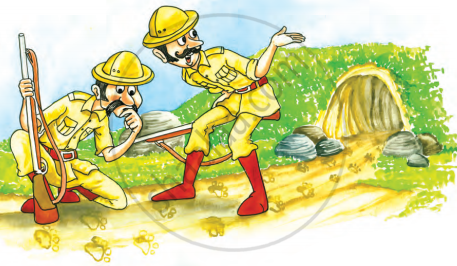
| Hunter 1 | “Look at the footprints in the mud!” |
| Hunter 2 | |
| Hunter 1 | |
| Hunter 2 |
Silent letter.
What is common in the following groups of words?
- knee, knife, knot, know ______
- neighbour, daughter, fight, straight ______
- honest, honour, hour, heir ______
Try and make more silent letter words.
gnat: ______, ______
tongue: ______, ______
chalk: ______, ______
whistle: ______, ______
Match the following and write complete sentences in the lines below.
| What was happening? | What happened? | |
| i | I was writing a letter. | the lights went out. |
| ii | Paul was looking out of the window | the bell rang. |
| iii | He was looking for his dog. | he noticed a lovely butterfly. |
| iv | I was just completing the last answer. | he fell off the ladder. |
| v | The man was painting the wall. | I met Arun. |
| vi | Amit was doing his homework. | my pen ran out. |
| vii | My mother was cooking dinner. | ma’am said, “Stop writing.” |
- I was writing a letter when ___________
- ________________
- *When I met Arun, he was looking for his dog.
- *_____________
- __________________
- _____________________
- _____________________
Rewrite the passage below using capital letters where necessary
oh dear said the fir tree I like my old needle-like leaves best for goats don't eat them and no man can steal them
This is Rajiv’s family. They are a healthy family. See what each one does to remain healthy.

Find one word from the story that means
to be inquisitive c ______.
Look at this sentence –
A library is a place where books are kept.
Now fill in the blanks after reading these sentences.
- An ______ is a place where aeroplanes take off and land.
- A ______ is a place where food is cooked.
- A ______ is a place where sick people are taken care of.
- A______is a place where you can buy thing.
- A______ is a place where children study.
The girl looked up at the ______of stars.
As Sletherby, would you apologize to Bertie for your rude behavior? Give reasons.
Why did Woman 1 panic more than the others?
Write the contraction for the following phrase.
have not - ______
Write a dialogue between a student and teacher on 'Importance of Yoga'.
Write letter to your father asking permission to go on a educational tour.
What was the very first thing that the children noticed when it stopped raining on Venus in Ray Bradbury's story. 'All Summer in a Day'?
These two passages are examples of a short introduction to works of art - a short review. They cover the following points:
- The name of the creator
- The theme or subject matter
- Type of art
- Individual style
- Presentation techniques
- Its effect on viewers
- Message or interpretation
What points will you include if you had to review a book or film or a play? List the points.
Observe the tourist leaflets given and answer the following.
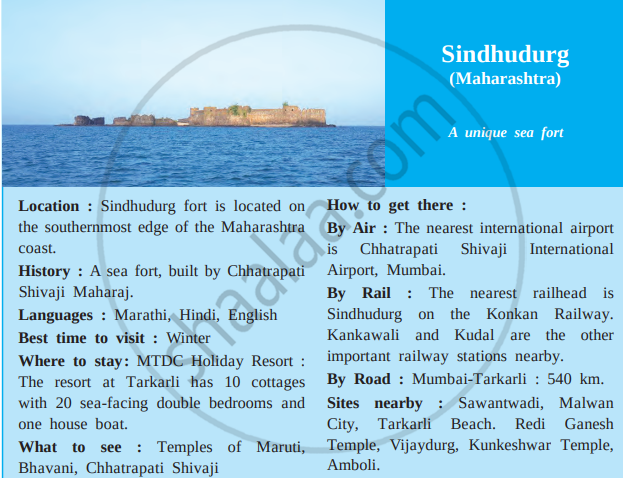

- Which places do these leaflets describe?
- What are the main points given in each leaflet?
- How can one reach Tadoba?
- Which is the best season to visit Tadoba? Why?
- List tourism-related words, e.g., tourist, booking etc.
Write a composition (in approximately 400-450 words) of the following subject:
Recently you attended the wedding of a close relative. It was the first family gathering after the pandemic. Describe the excitement of meeting all the family members, the venue of the wedding, the food that was served and the celebrations that followed.
