Advertisements
Advertisements
प्रश्न
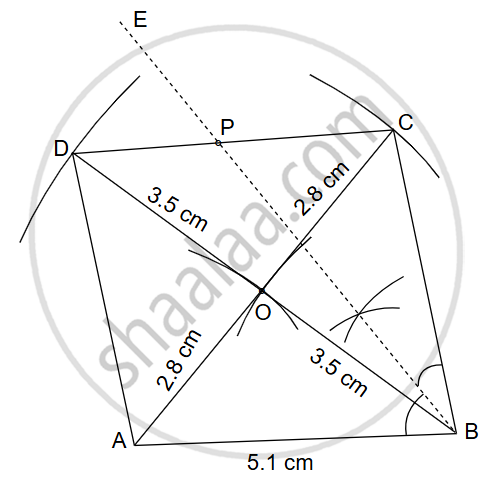
Without using set square or protractor, construct the parallelogram ABCD in which AB = 5.1 cm, the diagonals AC = 5.6 cm and the diagonal BD = 7 cm. Locate the point P on DC, which is equidistant from AB and BС.
ज्यामितीय चित्र
विस्तार में उत्तर
Advertisements
उत्तर
- Draw a line segment AB = 5.1 cm.
- Find the midpoint O of AC and BD (since diagonals of a parallelogram bisect each other).
Take AO = OC = 2.8 cm along one line, and BO = OD = 3.5 cm along another line through O to locate C and D. - Join A to C, B to C, A to D, and B to D to get parallelogram ABCD.
- At B, construct the angle bisector of ∠ABC and extend it to meet side DC at P.
In a parallelogram, diagonals bisect each other, so taking half of AC and BD from their intersection gives the correct positions of C and D. A point that is equidistant from the lines AB and BC lies on the angle bisector of ∠ABC. Therefore, the intersection point P of side DC with the angle bisector of ∠ABC is equidistant from AB and BC.
shaalaa.com
क्या इस प्रश्न या उत्तर में कोई त्रुटि है?
