Advertisements
Advertisements
प्रश्न
When the free ends of a tester are dipped into a solution, the magnetic needle shows deflection. Can you explain the reason?
Advertisements
उत्तर
When the free ends of a tester are dipped in a solution, the magnetic needle deflects. This happens because electric current is flowing through the tester. When its free ends are dipped in the solution, due to the flow of this electric current, a magnetic effect is generated in the magnetic needle, as a result of which the magnetic needle starts deflecting.
संबंधित प्रश्न
Most liquids that conduct electricity are solutions of ________, _______ and ________.
A tester is used to check the conduction of electricity through two liquids, labelled A and B. It is found that the bulb of the tester glows brightly for liquid A while it glows very dimly for liquid B. You would conclude that ______.
Does pure water conduct electricity? If not, what can we do to make it conducting?
In case of a fire, before the firemen use the water hoses, they shut off the main electrical supply for the area. Explain why they do this.
A child staying in a coastal region tests the drinking water and also the seawater with his tester. He finds that the compass needle deflects more in the case of seawater. Can you explain the reason?
Paheli had heard that rainwater is as good as distilled water. So, she collected some rain water in a clean glass tumbler and tested it using a tester. To her surprise, she found that the compass needle showed deflection. What could be the reasons?
Which one of the following solutions will not conduct electricity?
Observe the circuit given in the figure.
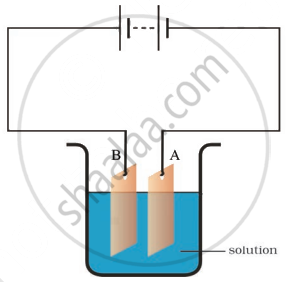
Boojho set up this circuit for purification of copper. What will be the nature of – (i) plate A (ii) plate B (iii) and the solution.
Explain the process of purification.
Boojho made the circuit as shown in the figure. He wanted to observe what happens when an electric current is passed through water. But he forgot to add a few drops of lemon juice to water. Will it make any difference to his observations? Explain.

Observing that the bulb does not glow in the circuit shown in the following figure A, Boojho changed the circuit as shown in the following figure B. He observed deflection in the magnetic compass.
 |
 |
| A | B |
- What does the deflection in magnetic compass indicate?
- Why did the bulb not glow in the following figure A?
- What would be the effect of increase in the number of turns in the coil wound around the magnetic compass in the following figure B?
- What will be observed if the number of cells are increased in the circuit shown in the following figure B?
