Advertisements
Advertisements
प्रश्न
What is menstrual cycle? Describe it in brief.
Advertisements
उत्तर
- The menstrual cycle is a series of cyclic changes that occur at intervals of about 28–30 days in a mature woman.
- It is controlled by pituitary hormones, namely FSH (Follicle Stimulating Hormone) and LH (Luteinizing Hormone), and ovarian hormones, estrogen and progesterone.
- Under the influence of FSH, the ovarian follicle containing the oocyte grows and matures.
- The growing follicle secretes estrogen.
- Estrogen stimulates the growth and regeneration of the inner lining of the uterus, called the endometrium.
- LH causes the mature follicle to burst and release the ovum. This process is called ovulation.
- After ovulation, the empty follicle is transformed into the corpus luteum, which secretes progesterone.
- Progesterone stimulates the endometrial glands to secrete nutrients and prepares the uterus for implantation of the fertilized ovum.
- If fertilization does not occur, the corpus luteum degenerates into the corpus albicans and stops secreting estrogen and progesterone.
- Due to the decrease in these hormones, the endometrium breaks down and is shed along with the unfertilized ovum through the vagina as menstrual flow, which lasts for about 3–5 days.
- If pregnancy does not occur, the menstrual cycle repeats regularly.
APPEARS IN
संबंधित प्रश्न
Explain menstrual cycle in human females.
Define the following term :
Ovulation
Observe the figure and answer the questions given below.
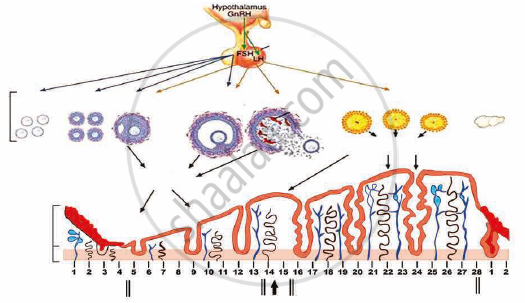
a) What does the above figure indicate?
b) Which human organs are involved in this process?
c) Name the hormones responsible for this process.
d) After how many days these repetitive changes take place?
e) ‚A woman should stay away from others, as her body is impure during this process.‛ What is your opinion about this statement? Elaborate it.
Mention, if the following statement is True or False. If false rewrite the wrong statement in its correct form:
Menarche is the stoppage of menstruation.
Multiple Choice Question:
The onset of menstruation in the female is termed
Multiple choice question.
Rupturing of follicles and discharge of ova is known as _______.
What are the phases of the menstrual cycle? Indicate the changes in the ovary and uterus.
The luteal phase of the menstrual cycle is also called the secretory phase. Give reason.
The temporary endocrine gland in humans is ______.
Immediately after ovulation, the mammalian egg is covered by a membrane known as ______.
Menstruation is triggered by a sudden decline in the amount of hormone secreted by corpus luteum. Identify the hormone.
The Corpus luteum grows during menstruation.
After ovulation the collapsed ovarian follicle shrinks and becomes filled with cell to form:
Why are menstrual cycles absent during pregnancy?
Given below is a flow chart showing ovarian changes during menstrual cycle. Fill in the spaces giving the name of the hormones responsible for the events shown.

In the figure given below, parts A and B show the level of hormones which influence the menstrual cycle. Study the figure and answer the questions that follow:
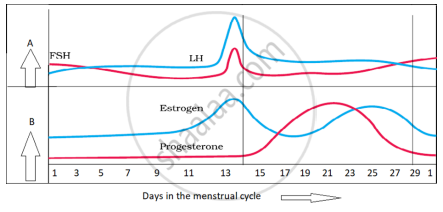
- Name the organs which secrete the hormones represented in parts A and B.
- State the impact of the hormones in part B on the uterus of the human female during 6 to 15 days of the menstrual cycle.
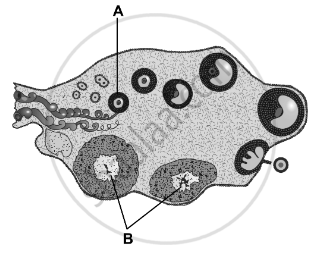
The figure show a section of human ovary. Select the option which gives the correct identification of either A or B with function/characteristic.
Which of the following statements are correct regarding female reproductive cycle?
- In non-primate mammals cyclical changes during reproduction are called oestrus cycle.
- First menstrual cycle begins at puberty and is called menopause.
- Lack of menstruation may be indicative of pregnancy.
- Cyclic menstruation extends between menarche and menopause.
Choose the most appropriate answer from the options given below:
Which of the following organs primarily undergo cyclic changes during the menstrual cycle?
What condition can cause a temporary stop in the menstrual cycle besides pregnancy?
