Advertisements
Advertisements
प्रश्न
What is an oxidising agent?
Explain the term Oxidising agent with example.
Advertisements
उत्तर १
An oxidising agent is a reactant which readily transfers oxygen atoms to another substance by reducing itself in the process.
उत्तर २
The substances which can give oxygen to other substances are called oxidant or oxidizing agents.
E.g. Potassium permanganate (KMnO4) and potassium dichromate (K2Cr2O7) in acidic or alkaline medium is commonly used oxidants.
संबंधित प्रश्न
Write three different chemical reactions showing the conversion of ethanoic acid to sodium ethanoate. Write balanced chemical equation in each case. Write the name of the reactants and the products other ethanoic acid and sodium ethanoate in each case.
When you add about 2 ml of acetic acid to a test tube containing an equal amount of distilled water and leave the test tube to settle after shaking its contents, what will you observe in the test tube after about 5 minutes?
(A) A white precipitate settling at its bottom
(B) A clear colourless solution
(C) A layer of water over the layer of acetic acid
(D) A layer of acetic acid over the layer of water
A student takes about 6 ml of distilled water in each of the four test tubes P, Q, R and S. He then dissolves an equal amount of four different salts namely, sodium chloride in 'P', potassium chloride in 'Q', calcium chloride in 'R' and magnesium chloride in 'S'. Next, he then adds 10 drops of soap solution to each test tube and shakes its contents. The test tubes in which scum (insoluble substance) is formed with soap are:
(A) P and Q
(B) Q and R
(C) R and S
(D) Q and S
What type of compound is formed when a carboxylic acid reacts with an alcohol in the presence of conc. H2SO4?
An organic compound X of molecular formula C2H4O2 gives brisk effervescence with sodium hydrogen carbonate. Give the name and formula of X.
Vinegar is a solution of about:
(a) 5 to 8 per cent ethanoic acid in alcohol
(b) 5 to 8 per cent ethanoic acid in water
(c) 50 to 80 per cent ethanoic acid in water
(d) 50 to 80 per cent ethanoic acid in alcohol
Consider the following organic compounds:
HCHO, C2H5OH, C2H6, CH3COOH, C2H5Cl
Choose two compounds which can react in the presence of conc. H2SO4 to form an ester. Give the name and formula of the ester formed.
What do you notice when acetic acid reacts with alcohol?
Acetic acid is a typical acid. Write one equation in case of its reactions with a bicarbonate.
Name the compound formed when acetic acid and ethanol react together.
Name the substance used to change acetic acid to acetic anhydride?
What do you observe when acetic acid is added to sodium bicarbonate?
If you take a pinch of sodium hydrogen carbonate powder in a test-tube and add drop-by-drop acetic acid to it, what would you observe immediately? List any two main observations.
Name the functional group present in the following compound:
C2H5CHO
A student takes Na2CO3 powder in a test tube and pours some drops of acetic acid over it. He observes:
(A) no reaction in the test tube
(B) colourless gas with pungent smell
(C) bubbles of a colourless and odourless gas
(D) white fumes with smell of vinegar
Draw the structural formula for the following:
Ethanoic acid
Write the molecular formula of the given compound.
Sodium ethanoate
Write the answers to the questions by observing the following figure.
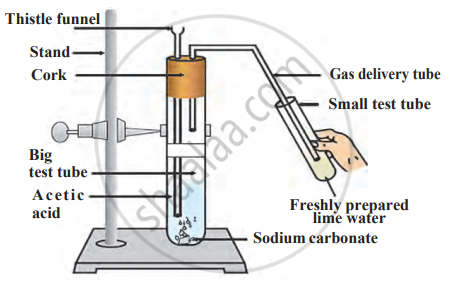
- Write the chemical reaction shown in the figure above in the form of a balanced equation.
- Write the name of the gas coming out of the large test tube in the above chemical reaction.
- Why do small bubbles of lime appear in the small test tube?
- What is the change in colour of lime net?
Mineral acids are stronger acids than carboxylic acids because
- mineral acids are completely ionised
- carboxylic acids are completely ionised
- mineral acids are partially ionised
- carboxylic acids are partially ionised
Write the chemical equation for the ethanol to ethanoic acid of an oxidation reaction.
