Advertisements
Advertisements
प्रश्न
What is an ideal machine?
Advertisements
उत्तर
A machine in which no part of the work done on the machine is wasted is called an ideal or perfect machine. Thus, for an ideal machine, the work output is equal to the work input, i.e., the efficiency of an ideal machine is 1 (or 100 percent).
APPEARS IN
संबंधित प्रश्न
When is work said to be done by a force?
A machine is 75% efficient’. What do you understand by this statement?
Derive the relationship between mechanical advantage, velocity ratio and efficiency of a machine.
The correct relationship between the mechanical advantage (M.A.), the velocity ratio (V.R.) and the efficiency (n) is ______.
What is an inclined plane?
Fig show a system of four pulleys. The upper two pulleys are fixed and the lower two are movable.
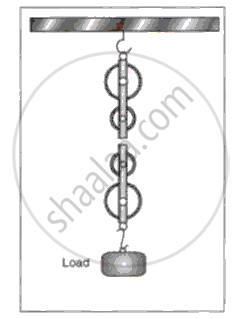
(i) Draw a string around the pulleys. Also show the place and direction in which the effort is applied.
(ii) What is the velocity ratio of the system?
(iii) What is the mechanical advantage of the system?
(iv) What assumption do you make in arriving at your answer in part (iii)?
Define velocity ratio.
Classify the following as a lever, a pulley and an inclined plane:
A wedge
Classify the following as a lever, a pulley and an inclined plane:
An opener
Rearrange the letters and find out the name of the tool.
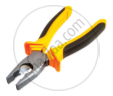
R L E V E
| ______ | ______ | ______ | ______ |
