Advertisements
Advertisements
प्रश्न
What do you understand by Linear combination of atomic orbitals in MO theory?
Advertisements
उत्तर
The wave functions for the molecular orbitals can be obtained by solving the Schrodinger wave equation for the molecule. Since solving the Schrodinger equation is too complex, approximation methods are used to obtain the wave function for molecular orbitals. The most common method is the linear combination of atomic orbitals (LCAO).
We know that the atomic orbitals are represented by the wave function ψ. Let us consider two atomic orbitals represented by the wave function ψA and ψB with comparable energy, combines to form two molecular orbitals. One is bonding molecular orbital `(ψ_"bonding")` and the other is antibonding molecular orbital `(ψ_"antibonding")` The wave functions for these two molecular orbitals can be obtained by the linear combination of the atomic orbitals ψA and ψB as below,
`(ψ_"bonding") = ψ_"A" + ψ_"B"`;
`(ψ_"antibonding") = ψ_"A" - ψ_"B"`;
The formation of bonding molecular orbital can be considered as the result of constructive interference of the atomic orbitals and the formation of anti-bonding molecular orbital can be the result of the destructive interference of the atomic orbitals. The formation of the two molecular orbitals from two is orbitals is shown below.
Constructive interaction:
The two 1s orbitals are in phase and have the same sign,


Destructive interaction:
The two orbitals are out phase

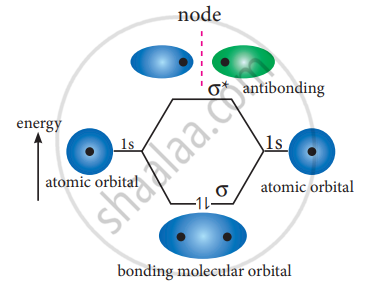
APPEARS IN
संबंधित प्रश्न
Select and write the most appropriate alternatives from the given choices.
Which O2 molecule is paramagnetic. It is explained on the basis of ______.
What are the interacting forces present during the formation of a molecule of a compound?
CaO and NaCl have the same crystal structure and approximately the same radii. If U is the lattice energy of NaCl, the approximate lattice energy of CaO is ______.
4p, 4d, 5s and 5p orbitals are arranged in the order of decreasing energy. The CORRECT option is:
Which one of the following sets CORRECTLY represents the increase in the paramagnetic property of the ions?
According to MOT, the number of unpaired electrons in O2 molecule is ____________.
Which element among the following does NOT form diatomic molecules?
Bonding in which of the following diatomic molecule(s) become(s) stronger, on the basis of MO Theory, by removal of an electron?
(A) NO
(B) N2
(C) O2
(D) C2
(E) B2
Choose the most appropriate answer from the options given below:
The correct statement with regard to \[\ce{H^+_2}\] and \[\ce{H^-_2}\] is:
Given below are two statements:
Statement I: A hypothetical diatomic molecule with bond order zero is quite stable.
Statement II: As bond order increases, the bond length increases. In the light of the above statements, chose the most appropriate answer from the options given below:
