Advertisements
Advertisements
प्रश्न
Verify whether the indicated numbers is zeroes of the polynomials corresponding to them in the following case:
`g(x)=3x^2-2,` `x=2/sqrt3 2/sqrt3`
Advertisements
उत्तर
`g(x)=3x^2-2, x=2/sqrt3 2/sqrt3`
we have `g(x)=3x^2 -2 `
put `x=2/sqrt3 and x=-2/sqrt3`
`⇒g(2/sqrt3)=3(2/sqrt3)^2-2 and g(-2/sqrt3)=3(-2/sqrt3)^2-2`
`=3xx4/3-2` `=3(4/3)-2`
`=4-2=2≠0` `=4-2=2≠0`
`∴=2/sqrt3, -2/sqrt3`are not roots of `g(x)=3x^2-2`
APPEARS IN
संबंधित प्रश्न
Find p(0), p(1) and p(2) for the following polynomial:-
p(y) = y2 – y + 1
Find the zero of the polynomial in the following case:
p(x) = 2x + 5
If `x = −1/2` is a zero of the polynomial `p(x)=8x^3-ax^2 -+2` find the value of a.
Find the value of the polynomial 5x – 4x2 + 3 at x = –1.
Find the number of zeros of the following polynomial represented by their graph
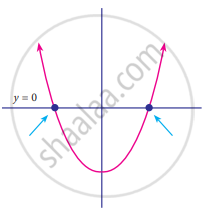
Find the number of zeros of the following polynomial represented by their graph
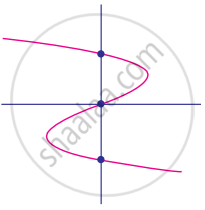
Find the number of zeros of the following polynomial represented by their graph
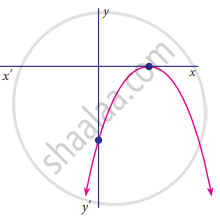
Find p(0), p(1), p(–2) for the following polynomial:
p(x) = 10x – 4x2 – 3
–3 is a zero of y2 + y – 6
Find the zeroes of the polynomial in the following:
p(x) = x – 4
