Advertisements
Advertisements
प्रश्न
Verify experimentally the laws reflection of sound.
Advertisements
उत्तर
The laws of reflection are:
- The angle in which the sound is incident is equal to the angle in which sound is reflected.
- Direction of incident sound, direction of the reflected sound and the normal are in the same plane.
Reflection of sound
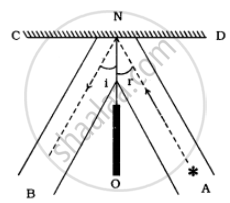
Take two metal tubes A and B. Keep one end of each tube on a metal plate as shown in figure. Place a wrist watch c at the open end of the tube A and interpose a cardboard between A and B. Now at a particular inclination of the tube B with the cardboard, ticking of the watch is clearly heard. The angle of reflection made by the tube B with the cardboard is equal to the angle of incidence made by the tube A with the cardboard.
For example, if the angle of incidence is 20° on the left side of a protractor (see figure arrangement), the angle of reflection at which we are able to hear the sound clearly will also be at 20° on the right side of the protractor.
∴ ∠ i = ∠ r ➝ verifying Law I
We will also further observe that pipe 1, pipe 2 i.e, the incident ray, reflected ray and the normal lie on the same plane, verifying law II.
