Advertisements
Advertisements
प्रश्न
Using the property of determinants and without expanding, prove that:
`|(1, bc, a(b+c)),(1, ca, b(c+a)),(1, ab, c(a+b))| = 0`
Advertisements
उत्तर
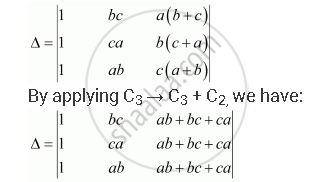
Here, two columns C1 and C3 are proportional.
∴Δ = 0.
APPEARS IN
संबंधित प्रश्न
Using properties of determinants, show that ΔABC is isosceles if:`|[1,1,1],[1+cosA,1+cosB,1+cosC],[cos^2A+cosA,cos^B+cosB,cos^2C+cosC]|=0`
Using properties of determinants, prove that
`|((x+y)^2,zx,zy),(zx,(z+y)^2,xy),(zy,xy,(z+x)^2)|=2xyz(x+y+z)^3`
If ` f(x)=|[a,-1,0],[ax,a,-1],[ax^2,ax,a]| ` , using properties of determinants find the value of f(2x) − f(x).
Using the property of determinants and without expanding, prove that:
`|(2,7,65),(3,8,75),(5,9,86)| = 0`
By using properties of determinants, show that:
`|(0,a, -b),(-a,0, -c),(b, c,0)| = 0`
By using properties of determinants, show that:
`|(1+a^2-b^2, 2ab, -2b),(2ab, 1-a^+b^2, 2a),(2b, -2a, 1-a^2-b^2)| = (1+a^2+b^2)`
Using properties of determinants, prove that
`|(a^2 + 2a,2a + 1,1),(2a+1,a+2, 1),(3, 3, 1)| = (a - 1)^3`
Using properties of determinants, prove that `|(1,1,1+3x),(1+3y, 1,1),(1,1+3z,1)| = 9(3xyz + xy + yz+ zx)`
Using properties of determinants, prove that:
`|(a,b,b+c),(c,a,c+a),(b,c,a+b)|` = (a+b+c)(a-c)2
Using properties of determinants, prove that:
`|[a^2 + 1, ab, ac], [ba, b^2 + 1, bc ], [ca, cb, c^2+1]| = a^2 + b^2 + c^2 + 1`
Using properties of determinant prove that
`|(b+c , a , a), (b , c+a, b), (c, c, a+b)|` = 4abc
Using properties of determinants, prove the following:
`|(a, b,c),(a-b, b-c, c-a),(b+c, c+a, a+b)| = a^3 + b^3 + c^3 - 3abc`.
Using properties of determinants, find the value of x for which
`|(4-"x",4+"x",4+"x"),(4+"x",4-"x",4+"x"),(4+"x",4+"x",4-"x")|= 0`
Evaluate the following determinants:
`|(x - 1, x, x - 2),(0, x - 2, x - 3),(0, 0, x - 3)| = 0`
Using properties of determinants, show that `|("a" + "b", "a", "b"),("a", "a" + "c", "c"),("b", "c", "b" + "c")|` = 4abc.
If `|(4 + x, 4 - x, 4 - x),(4 - x, 4 + x, 4 - x),(4 - x, 4 - x, 4 + x)|` = 0, then find the values of x.
Without expanding determinants, find the value of `|(2014, 2017, 1),(2020, 2023, 1),(2023, 2026, 1)|`
Without expanding determinants, prove that `|(1, yz, y + z),(1, zx, z + x),(1, xy, x + y)| = |(1, x, x^2),(1, y, y^2),(1, z, z^2)|`.
By using properties of determinants, prove that `|(x + y, y + z, z + x),(z, x, y),(1, 1, 1)|` = 0.
Without expanding the determinants, show that `|(x"a", y"b", z"c"),("a"^2, "b"^2, "c"^2),(1, 1, 1)| = |(x, y, z),("a", "b", "c"),("bc", "ca", "ab")|`
Select the correct option from the given alternatives:
`|("b" + "c", "c" + "a", "a" + "b"),("q" + "r", "r" + "p", "p" + "q"),(y + z, z + x, x + y)|` =
Answer the following question:
Evaluate `|(101, 102, 103),(106, 107, 108),(1, 2, 3)|` by using properties
Answer the following question:
By using properties of determinant prove that `|(x + y, y + z, z + x),(z, x, y),(1, 1, 1)|` = 0
Evaluate: `|(x^2 - x + 1, x - 1),(x + 1, x + 1)|`
Evaluate: `|(3x, -x + y, -x + z),(x - y, 3y, z - y),(x - z, y - z, 3z)|`
The number of distinct real roots of `|(sinx, cosx, cosx),(cosx, sinx, cosx),(cosx, cosx, sinx)|` = 0 in the interval `pi/4 x ≤ pi/4` is ______.
`|(x + 1, x + 2, x + "a"),(x + 2, x + 3, x + "b"),(x + 3, x + 4, x + "c")|` = 0, where a, b, c are in A.P.
The determinant `|(sin"A", cos"A", sin"A" + cos"B"),(sin"B", cos"A", sin"B" + cos"B"),(sin"C", cos"A", sin"C" + cos"B")|` is equal to zero.
Let Δ = `|("a", "p", x),("b", "q", y),("c", "r", z)|` = 16, then Δ1 = `|("p" + x, "a" + x, "a" + "p"),("q" + y, "b" + y, "b" + "q"),("r" + z, "c" + z, "c" + "r")|` = 32.
Using properties of determinants `abs ((1, "a", "a"^2 - "bc"),(1, "b", "b"^2 - "ca"),(1, "c", "c"^2 - "ab")) =` ____________.
Which of the following is correct?
The value of the determinant `|(6, 0, -1),(2, 1, 4),(1, 1, 3)|` is ______.
By using properties of determinant prove that
`|(x+ y,y+z, z+x ),(z, x,y),(1,1,1)|` = 0
Without expanding determinants find the value of `|(10,57,107),(12,64,124),(15,78,153)|`
By using properties of determinant prove that `|(x+y,y+z,z+x),(z,x,y),(1,1,1)|=0`
Without expanding the determinant, find the value of `|(10,57,107),(12,64,124),(15,78,153)|`
