हिंदी

Using the Necessary Circuit Diagrams, Show How the V-I Characteristics of a p-n Junction Are Obtained in Reverse Biasing - Physics

Advertisements
Advertisements

प्रश्न

Using the necessary circuit diagrams, show how the V-I characteristics of a p-n junction are obtained in

Reverse biasing

How are these characteristics made use of in rectification?

Advertisements

उत्तर

p-n junction diode under reverse bias
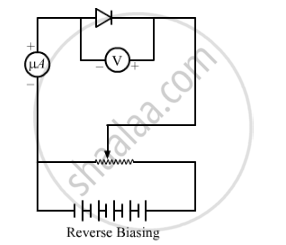
Positive terminal of battery is connected to n-side and negative terminal to p-side.

Reverse bias supports the potential barrier. Therefore, the barrier height increases and the width of depletion region also increases.

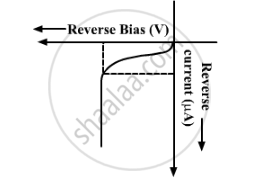
Due to the majority carriers, there is no conduction across the junction. A few minority carriers cross the junction after being accelerated by high reverse bias voltage.

This constitutes a current that flows in opposite direction, which is called reverse current.

The V-I characteristics of p-n junction diode in reverse bias is shown below:
p-n junction diode is used as a half-wave rectifier. Its working is based on the fact that the resistance of p-n junction becomes low when forward biased and becomes high when reverse biased. These characteristics of diode is used in rectification.

shaalaa.com
  क्या इस प्रश्न या उत्तर में कोई त्रुटि है?
2013-2014 (March) Delhi Set 1

वीडियो ट्यूटोरियलVIEW ALL [3]

संबंधित प्रश्न

Colour of light emitted by LED depends upon__________________ .

  1. its forward bias
  2. its reverse bias
  3. the band gap of the material of semiconductor
  4. its size

With what considerations in view, a photodiode is fabricated? State its working with the help of a suitable diagram.

Even though the current in the forward bias is known to be more than in the reverse bias, yet the photodiode works in reverse bias. What is the reason?


Write briefly the important processes that occur during the formation of p−n junction. With the help of necessary diagrams, explain the term 'barrier potential'.


Draw V − I characteristics of a p-n junction diode. Answer the following questions, giving reasons:

(i) Why is the current under reverse bias almost independent of the applied potential up to a critical voltage?

(ii) Why does the reverse current show a sudden increase at the critical voltage?

Name any semiconductor device which operates under the reverse bias in the breakdown region.


The plate resistance of a triode is 8 kΩ and the transconductance is 2.5 millimho. (a) If the plate voltage is increased by 48 V and the grid voltage is kept constant, what will be the increase in the plate current? (b) With plate voltage kept constant at this increased value, by how much should the grid voltage be decreased in order to bring the plate current back to its initial value?


With reference to Semiconductor Physics,

Name the process that causes depletion region in a p-n junction.


Pressure P varies as P = `alpha/beta "exp" (- (alpha x)/"k"_"BT")`, where x denotes the distance, kB is the Boltzmann's constant, T is the absolute temperature and α and β are constant. The dimension of β is ______.


A p-n photodiode is fabricated from a semiconductor with a band gap of 2.5 eV. lt can detect a signal of wavelength ______.


If the resistance R1 is increased (Figure), how will the readings of the ammeter and voltmeter change?


What energy conversion takes place in a solar cell?


Share
Notifications

Englishहिंदीमराठी


      Forgot password?
Use app×