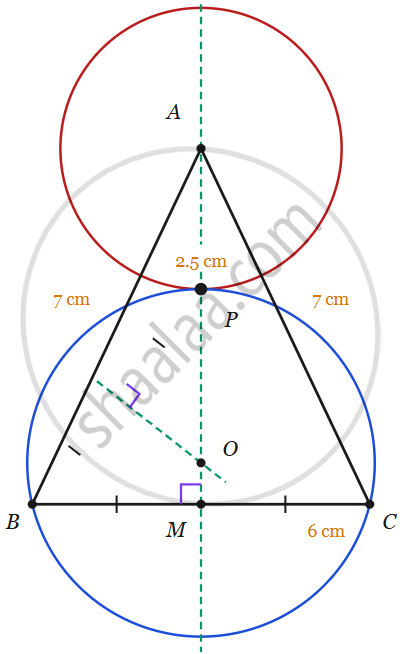
Use ruler and compass for the following constructions: Construct: (i) an isosceles triangle ABC in which AB = AC = 7 cm and BC = 6 cm. (ii) the locus of points which moves such that it is 2.5 cm
Advertisements
प्रश्न
Use ruler and compass for the following constructions:
Construct:
(i) an isosceles ΔABC in which AB = AC = 7 cm and BC = 6 cm.
(ii) the locus of points which moves such that it is 2.5 cm from the point A.
(iii) the locus of points equidistant from B and C. Mark point P which satisfies both the conditions mentioned in (ii) and (iii).
(iv) a circle passing through P, B and C.
Advertisements
उत्तर
\[\begin{array}{r l} \textbf{Given:} & \text{An isosceles triangle } ABC \text{ in which } AB = AC = 7 \text{ cm and } BC = 6 \text{ cm.} \\[4pt] \textbf{To Find:} & \text{The locus of a point } 2.5 \text{ cm from } A, \text{ the locus of a point equidistant from } B \text{ and } C, \text{ the point } P \text{ satisfying both, and the circle through } P, B \text{ and } C. \\[4pt] \textbf{Solution:} & \text{Step 1: Draw } BC = 6 \text{ cm; with centre } B \text{ and centre } C, \text{ each with radius } 7 \text{ cm, draw arcs meeting at } A, \text{ and join } AB \text{ and } AC. \\[4pt] & \text{Step 2: The locus of a point at a fixed distance from a fixed point is a circle, so the locus in (ii) is the circle with centre } A \text{ and radius } 2.5 \text{ cm.} \\[4pt] & \text{Step 3: The locus of a point equidistant from two fixed points is the perpendicular bisector of the line segment joining them, so the locus in (iii) is the perpendicular bisector of } BC, \text{ which meets } BC \text{ at its midpoint } M \text{ and passes through } A \text{ since } AB = AC. \\[4pt] & \text{Step 4: This perpendicular bisector cuts the circle at } P, \text{ the required point, with } AP = 2.5 \text{ cm.} \\[4pt] & \text{Step 5: Draw the perpendicular bisector of } PB; \text{ it meets the perpendicular bisector of } BC \text{ at } O, \text{ and the circle with centre } O \text{ and radius } OP \text{ passes through } P, B \text{ and } C. \\[4pt] & \text{Let } OM = x \text{ and } R = OP, \text{ so that by Pythagoras' theorem in the right triangles } ABM \text{ and } OBM : \\[4pt] & \begin{aligned} AM^{2} &= AB^{2} - BM^{2} \\[4pt] &= 49 - 9 \\[4pt] &= 40 \\[4pt] AM &= 2\sqrt{10} \\[4pt] &\approx 6.32 \\[4pt] PM &= AM - AP \\[4pt] &= 2\sqrt{10} - \frac{5}{2} \\[4pt] &\approx 3.82 \\[4pt] BM^{2} + OM^{2} &= (PM - OM)^{2} \\[4pt] x &= \frac{PM^{2} - 9}{2\,PM} \\[4pt] R &= PM - x \\[4pt] &= \frac{PM^{2} + 9}{2\,PM} \\[4pt] &= \frac{76\sqrt{10} - 55}{60} \\[4pt] &\approx 3.09 \end{aligned} \\[4pt] \textbf{Answer:} & P \text{ is the point where the perpendicular bisector of } BC \text{ cuts the circle of centre } A \text{ and radius } 2.5 \text{ cm, and the circle through } P, B \text{ and } C \text{ has centre } O \text{ on } AM \text{ with radius } \dfrac{76\sqrt{10} - 55}{60} \text{ cm} \approx 3.09 \text{ cm.} \end{array}\]