Use a graph paper for this question. Take 2 cm = 1 unit along both the axes. i. Plot the points A(0, 4), B(2, 2), C(5, 2) and D(4, 0). E(0, 0) is the origin. ii. Reflect B, C, D on the y-axis
Advertisements
प्रश्न
Use a graph paper for this question. Take 2 cm = 1 unit along both the axes.
- Plot the points A(0, 4), B(2, 2), C(5, 2) and D(4, 0). E(0, 0) is the origin.
- Reflect B, C, D on the y-axis and name them as B', C' and D' respectively.
- Join the points ABCD D'C'B' and A in order and give a geometrical name to the closed figure.
आलेख
Advertisements
उत्तर
Here’s the graph (1 big square = 1 unit = 2 cm):
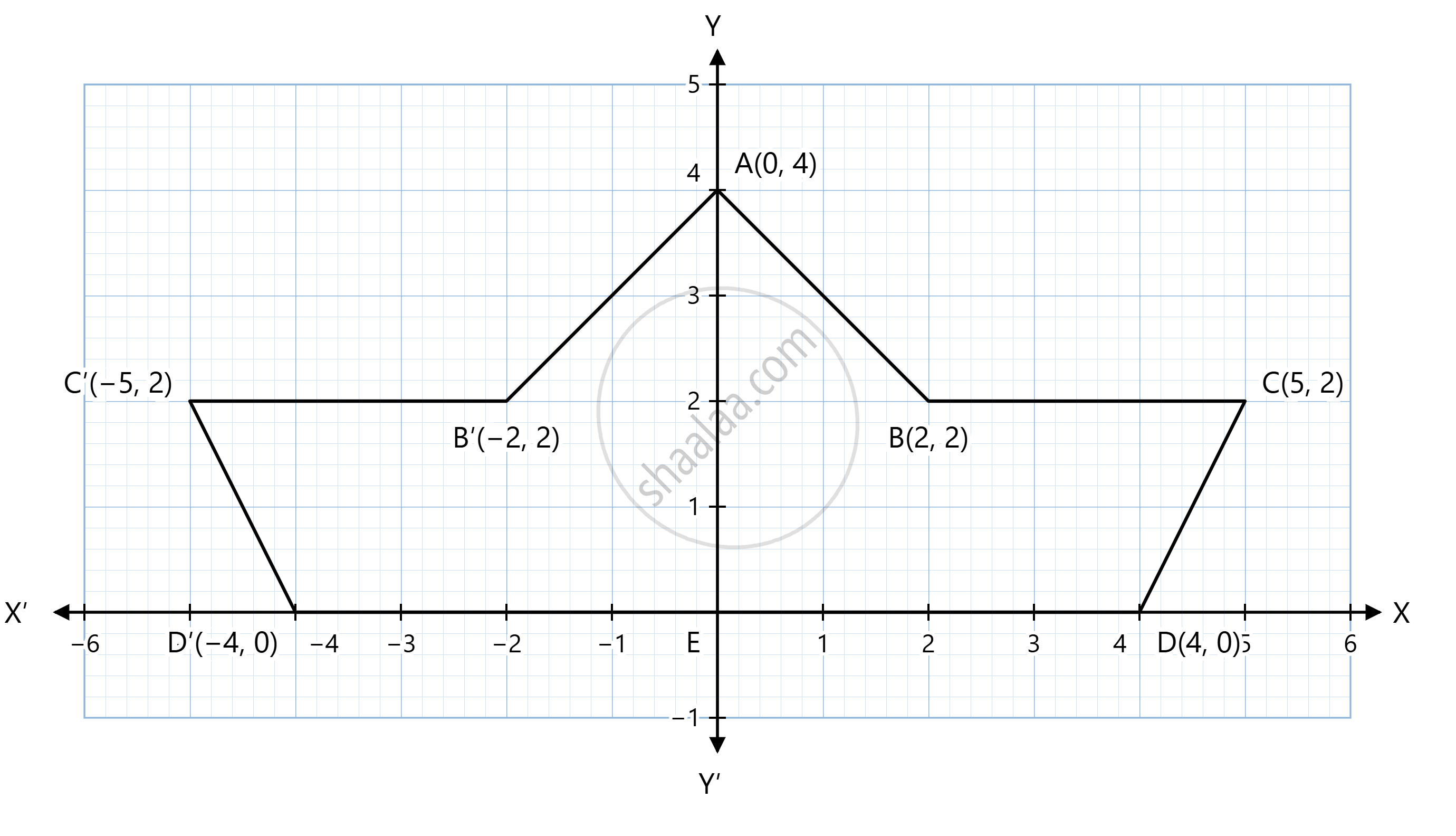
i. A(0, 4), B(2, 2), C(5, 2) and D(4, 0) are plotted on the graph, with E(0, 0) at the origin.
ii. Reflection in the y-axis maps (x, y) to (–x, y). The images are:
B′(–2, 2)
C′(–5, 2)
D′(–4, 0)
iii. Joining A, B, C, D, D′, C′, B′ and back to A gives a closed figure with 7 sides. So its geometrical name is a heptagon. It is a concave heptagon, because the angles at B and B′ point inwards. The y-axis is its line of symmetry.
shaalaa.com
क्या इस प्रश्न या उत्तर में कोई त्रुटि है?
