Use a graph paper for this question. Plot the points P(3, 2) and Q(–3, –2). From P and Q, draw perpendiculars PM and QN on the x-axis. (i) Name the image of P on reflection in the origin.
Advertisements
प्रश्न
Use a graph paper for this question. Plot the points P(3, 2) and Q(–3, –2). From P and Q, draw perpendiculars PM and QN on the x-axis.
(i) Name the image of P on reflection in the origin.
(ii) Assign the special name to the geometrical figure PMQN and find its area.
(iii) Write the co-ordinates of the point to which M is mapped on reflection in (a) x-axis (b) y-axis (c) origin.
Advertisements
उत्तर
Here’s the graph:
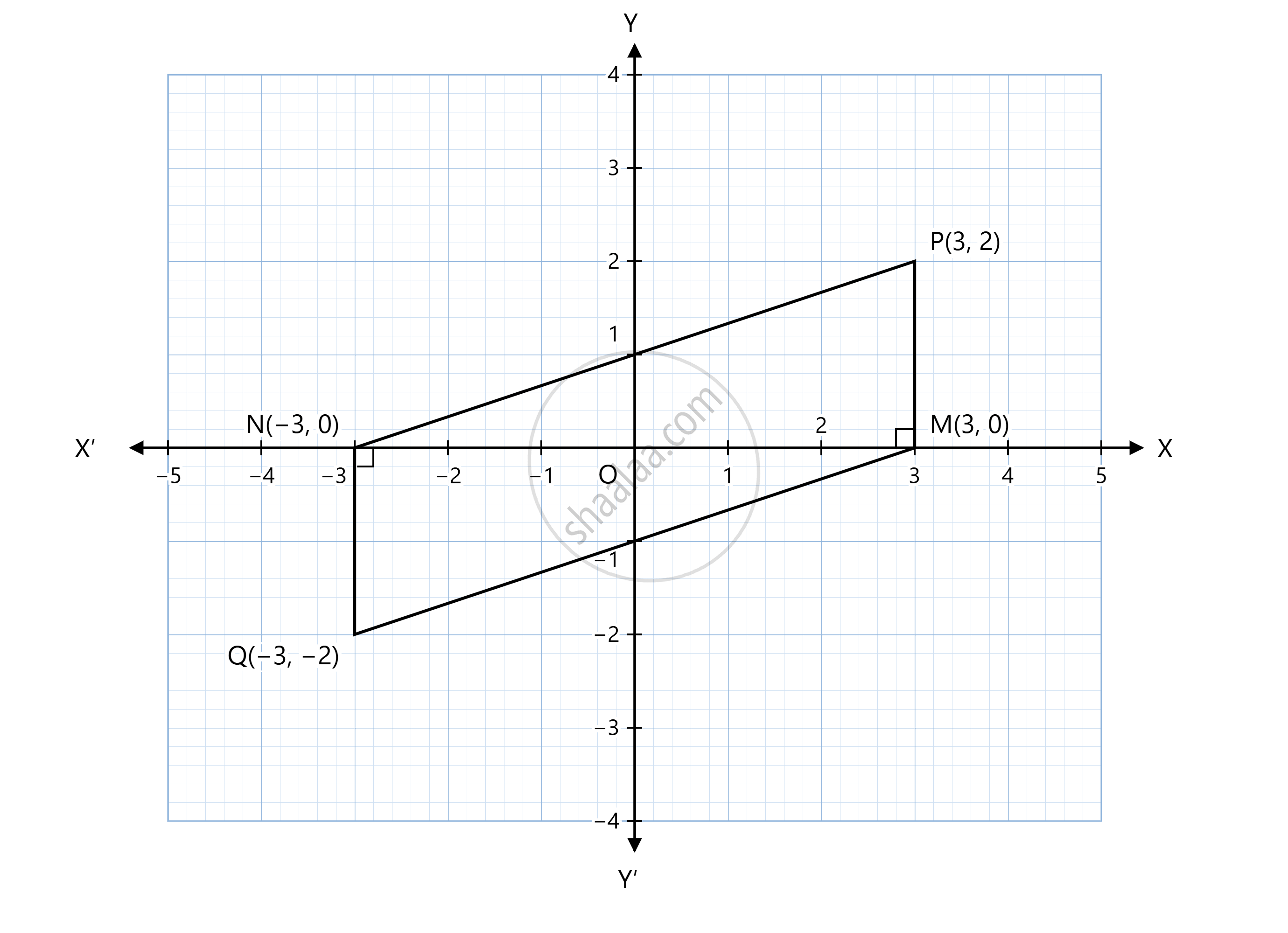
(i) Reflection in the origin maps (x, y) to (–x, –y), so P(3, 2) → (–3, –2). The image of P is Q.
(ii) PMQN is a parallelogram. PM and QN are both perpendicular to the x-axis, so PM || QN. Their lengths are also equal: PM = QN = 2 units.
To find the area, take PM as the base. The height is the distance between PM and QN, which is MN.
Base PM = 2 units.
Height MN = 3 – (–3) = 6 units.
Area = base × height = 2 × 6 = 12 sq. units.
(iii) M is (3, 0).
(a) In the x-axis, M is mapped to (3, 0). M lies on the x-axis, so it is its own image.
(b) In the y-axis, M is mapped to (–3, 0), which is N.
(c) In the origin, M is mapped to (–3, 0), which is N.
