Advertisements
Advertisements
प्रश्न
Under what condition a charge undergoes uniform circular motion in a magnetic field? Describe, with a neat diagram, cyclotron as an application of this principle. Obtain an expression for the frequency of revolution in terms of the specific charge and magnetic field.
Advertisements
उत्तर
A charged particle undergoes uniform circular motion in a magnetic field when its velocity is perpendicular to the magnetic field.
`vec v` ⊥ `vec B`
Then the magnetic force,
F = qvB
always acts perpendicular to the velocity and provides the required centripetal force.
qvB = `(mv^2)/r`
Thus, the particle moves in a circle with constant speed.
A cyclotron is a device used to accelerate positively charged particles such as protons and ions to high energies.
Construction: It consists of two hollow D-shaped metal chambers called dees, placed in a vacuum chamber between the poles of a strong electromagnet. A high-frequency alternating potential difference is applied between the two dees.
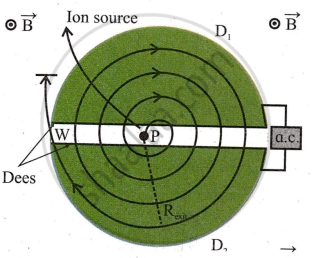
Working: A charged particle released near the centre is accelerated across the gap between the dees by the electric field. Inside a dee, there is practically no electric field. The magnetic field makes the particle move along a semicircular path. Each time the particle crosses the gap, the polarity of the dees reverses and the particle gains more kinetic energy. As its speed increases, the radius of its path increases, so it follows an outward spiral path.
For a particle of mass mm, charge q, speed v, moving in a circular path of radius r,
\[F_m = qvB\]This magnetic force provides the centripetal force:
qvB = \[\frac{mv^2}{r}\]Therefore,
r = \[\frac{mv}{qB}\]Time required to complete one semicircle is
t = \[\frac{\pi r}{v}\]Substituting r = \[\frac{mv}{qB}\],
t = \[\frac{\pi m}{qB}\]Hence, the time period of one complete revolution is
T = 2t = \[\frac{2\pi m}{qB}\]Therefore, the frequency of revolution is
f = \[\frac{qB}{2\pi m}\]Since the specific charge is qm\frac{q}{m},
f = \[\frac{1}{2\pi}\left(\frac{q}{m}\right)B\]Thus, the cyclotron frequency depends on the magnetic field BB and the specific charge q/mq/m of the particle, and is independent of its speed and the radius of its path.
