Advertisements
Advertisements
प्रश्न
Two sticks each of length 7 cm are crossing each other such that they bisect each other at right angles. What shape is formed by joining their end points? Give reason.
Advertisements
उत्तर
Sticks can be treated as the diagonals of a quadrilateral.
Now, since the diagonals (sticks) are bisecting each other at right angles, therefore the shape formed by joining their end points will be a rhombus.
APPEARS IN
संबंधित प्रश्न
Diagonals AC and BD of a parallelogram ABCD intersect each other at O. If OA = 3 cm and OD = 2 cm, determine the lengths of AC and BD.
Diagonals of a parallelogram are perpendicular to each other. Is this statement true? Give reason for your answer.
E and F are points on diagonal AC of a parallelogram ABCD such that AE = CF. Show that BFDE is a parallelogram.
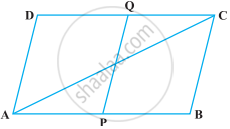
Points P and Q have been taken on opposite sides AB and CD, respectively of a parallelogram ABCD such that AP = CQ (Figure). Show that AC and PQ bisect each other.
In a parallelogram ABCD, AB = 10 cm and AD = 6 cm. The bisector of ∠A meets DC in E. AE and BC produced meet at F. Find the length of CF.
A diagonal of a parallelogram bisects one of its angles. Show that it is a rhombus.
ABCD is a rectangle in which diagonal BD bisects ∠B. Show that ABCD is a square.
P is the mid-point of the side CD of a parallelogram ABCD. A line through C parallel to PA intersects AB at Q and DA produced at R. Prove that DA = AR and CQ = QR.
If diagonals of a quadrilateral bisect each other, it must be a parallelogram.
Two sticks each of length 5 cm are crossing each other such that they bisect each other. What shape is formed by joining their endpoints? Give reason.
