Advertisements
Advertisements
प्रश्न
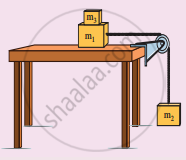
Two masses m1 and m2 are connected with a string passing over a frictionless pulley fixed at the comer of the table as shown in the figure. The coefficient of static friction of mass m1 with the table is µs Calculate the minimum mass m3 that may be placed on m1 to prevent it from sliding. Check if m1 = 15 kg, m2 = 10 kg, m3 = 25 and µs = 0.2.
Advertisements
उत्तर
Let m3 is the mass added on m1
Maximal static friction
`f_s^max` = µsN = µs (m1 + m3)g
Here,
N = (m1 + m3)g
Tension acting on string = T = m2 g
Equate (1) and (2)
µs(m1 + m3) = m2g
µsm1 + µsm3 = m2
m3 = `f_s^max` – m1
(ii) Given,
m1 = 15 kg, m2 = 10 kg : m3 = 25 kg and µs = 0.2
m3 = `f_s^max` – m1
m3 = `10/0.2` – 15 = 50 – 15 = 35 kg
The minimum mass m3 = 35 kg has to be placed on ml to prevent it from sliding. But here m3 = 25 kg only.
The combined masses (m1 + m3) will slide.
APPEARS IN
संबंधित प्रश्न
An object of mass m begins to move on the plane inclined at an angle θ. The coefficient of static friction of inclined surfaces is µs. The maximum static friction experienced by the mass is ______
Explain various types of friction.
Suggest a few methods to reduce friction.
State the empirical laws of static and kinetic friction.
A heavy uniform chain lies on a horizontal table. If the coefficient of friction between the chain and the table is 0.25, then the maximum fraction of the length of the chain that can hang over one edge of the table is
A block of mass 20 kg is sliding on a surface is inclined at an angle of 45° with the horizontal. What will be the acceleration of the block if the coefficient of kinetic friction between the block and the surface is 0.7?
If a body of mass m is moving on a rough horizontal surface of coefficient of kinetic friction µ, the net resultant force exerted by surface on the body is ______.
A 40 kg wooden crate is being pushed across a wooden floor with a force of 160 N. If µk = 0.3, the acceleration of the crate is ______ m/s2. (g = 10 m/s2}
The coefficient of static friction between a car's tires and a level road is 0.80. If the car is to be stopped in a maximum time of 3.0 s, its speed cannot exceed.
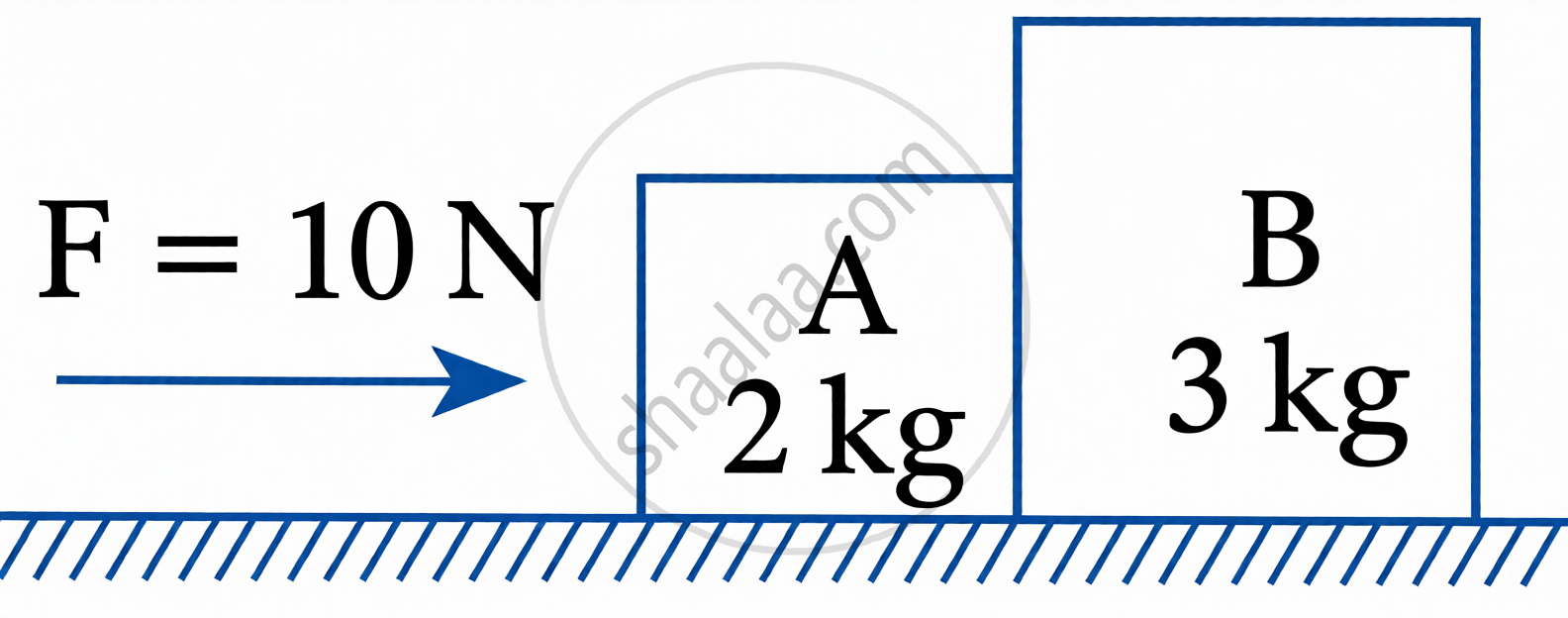
A horizontal force 10 N is applied to a block A as shown in figure. The mass of blocks A and B are 2 kg and 3 kg, respectively. The blocks slide over a frictionless surface. The force exerted by block A on block B is: