हिंदी
कर्नाटक बोर्ड पी.यू.सी.पीयूसी विज्ञान 2nd PUC Class 12

To ensure almost 100 per cent transmissivity, photographic lenses are often coated with a thin layer of dielectric material. The refractive index of this material is intermediated between - Physics

Advertisements
Advertisements

प्रश्न

To ensure almost 100 per cent transmissivity, photographic lenses are often coated with a thin layer of dielectric material. The refractive index of this material is intermediated between that of air and glass (which makes the optical element of the lens). A typically used dielectric film is MgF2 (n = 1.38). What should the thickness of the film be so that at the center of the visible spectrum (5500 Å) there is maximum transmission.

दीर्घउत्तर
Advertisements

उत्तर

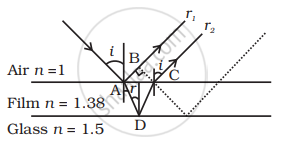
Consider a ray incident at an angle i. A part of this ray is reflected from the air-film interface and a part is refracted inside. This is partly reflected at the film-glass interface and a part transmitted. A part of the reflected ray is reflected at the film-air interface and a part is transmitted as r2 parallel to r1. Of course, successive reflections and transmissions will keep on decreasing the amplitude of the wave. Hence rays r1 and r2 shall dominate the behaviour. If the incident light is to be transmitted through the lens, r1 and r2 should interfere destructively. Both the reflections at A and D are from lower to higher refractive index and hence there is no phase change on reflection. The optical path difference between r2 and r1 is n (AD + CD) – AB.

If d is the thickness of the film, then

`AD = CD = d/cos r`

`AB = AC sin i`

`(AC)/2` = d tan r

∴ `AC = 2d tan r`

Hence, `AB = 2d tanr sini`

Thus the optical path difference is
`2n  d/cos r - 2d tan r sin i`

= `2. sin i/sin r d/cos r - 2d sinr/cos r sin i`

= `2d sin [(1 - sin^2r)/(sinr cos r)]`

= `2 nd cos r`

For these waves to interfere destructively this must be `λ/2`.

⇒ `2nd cos r = λ/2`

or `nd cos r = λ/4`

For a camera lens, the sources are in the vertical plane and hence `i ≃ r ≃ 0`

∴ `nd ≃ λ/4`

⇒ `d = (5500 Å)/(1.38 xx 4) ≃ 1000 Å`

shaalaa.com
  क्या इस प्रश्न या उत्तर में कोई त्रुटि है?
अध्याय 10: Wave Optics - MCQ I [पृष्ठ ६७]

APPEARS IN

एनसीईआरटी एक्झांप्लर Physics [English] Class 12
अध्याय 10 Wave Optics
MCQ I | Q 10.23 | पृष्ठ ६७

वीडियो ट्यूटोरियलVIEW ALL [3]

संबंधित प्रश्न

If the polarising angle for a given medium is 60°, then the refractive index of the medium is.................


What is a Polaroid?


What dose a polaroid consist of?


How does one demonstrate, using a suitable diagram, that unpolarised light when passed through a Polaroid gets polarised?


Show, with the help of a diagram, how unpolarised sunlight gets polarised due to scattering.


Two polaroids P1 and P2 are placed with their pass axes perpendicular to each other. Unpolarised light of intensity I0 is incident on P1. A third polaroid P3 is kept in between P1 and P2 such that its pass axis makes an angle of 60° with that of P1. Determine the intensity of light transmitted through P1, P2 and P3.


A beam of light is incident at the polarizing angle of 35° on a certain glass plate. The refractive index of the glass plate is : 


Explain how an unpolarised light gets polarised when incident on the interface separating the two transparent media.


What is unpolarised light?


What is partially polarised light?


What is the angle of polarisation and obtain the equation for an angle of polarisation?


Discuss about Nicol prism.


How is polarisation of light obtained by scattering of light?


An unpolarised light of intensity 32 Wm-2 passes through three Polaroids such that the axes of the first and the last Polaroids are at 90°. What is the angle between the axes of the first and middle Polaroids so that the emerging light has an intensity of only 3 Wm-2?


The reflected light is found to be plane polarised when an unpolarized light falls on a denser medium at 60° with the normal. Find the angle of refraction and critical angle of incidence for total internal reflection in the denser to rarer medium reflection.


A plane mirror produces a magnification of


Can reflection result in plane polarised light if the light is incident on the interface from the side with higher refractive index?


A polarizer - analyser set is adjusted such that the intensity of light coming out of the analyser is just 10% of the original intensity. Assuming that the polarizer - analyser set does not absorb any light, the angle by which the analyser need to be rotated further to reduce the output intensity to be zero, is ______.


Share
Notifications

Englishहिंदीमराठी


      Forgot password?
Use app×