Advertisements
Advertisements
प्रश्न
Three-point charges +q, +2q and Q are placed at the three vertices of an equilateral triangle. Find the value of charge Q (in terms of q), so that the electric potential energy of the system is zero.
Advertisements
उत्तर
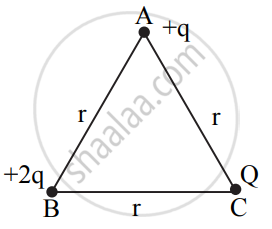
Let ‘r’ be the side of the equilateral triangle,
`("U")_"AB" = 1/(4piε_0).("q".2"q")/"r"`
`("U")_"BC" = 1/(4piε_0).(2"q"."Q")/"r"`
`("U")_"AC" = 1/(4piε_0).("q"."Q")/"r"`
Since the electric potential energy of the system is zero.
∴ `("U")_"AB" + ("U")_"BC" + ("U")_"AC" = 0`
∴ `1/(4piε_0).(2"q"^2)/"r" + 1/(4piε_0).(2"q""Q")/"r" + 1/(4piε_0).("q""Q")/"r" = 0`
∴ 2q2 + 2qQ + qQ = 0
∴ 3qQ = -2q2
∴ Q = `(-2"q")/3`
∴ The value of charge Q (in terms of q) is `underline((-2"q")/3).`
संबंधित प्रश्न
A charge 6 µC is placed at the origin and another charge - 5 µC is placed on the y-axis at A = (0, 6.0 m).

(a) Calculate the net electric potential at P = (8.0 m, 0).
(b) Calculate the work done in bringing a proton from infinity to point P. What is the significance of the negative sign?
One hundred and twenty five small liquid drops, each carrying a charge of 0.5 µC and of diameter 0.1 m form a bigger drop. Calculate the potential at the surface of the bigger drop.
If an electron is brought towards another electron, the electric potential energy of the system ______.
Find the electric potential at the surface of an atomic nucleus (Z = 50) of radius 9 × 10-13 cm.
Obtain an expression for the potential energy of a dipole in an external field.
Derive an expression for the electric potential due to an electric dipole.
In a certain region of space with volume 0.2 m3 , the electric potential is found to be 5V throughout. The magnitude of electric field in this region is: ____________.
The electric potential V at any point O (x, y, z all in metres) in space is given by V = 4x2 volt. The electric field at the point (1 m, 0, 2m) in volt/metre is ____________.
Two parallel plates separated by a distance 'd' are kept at potential difference 'V' volt. A charge 'q' of mass 'm' enters in parallel plates with some velocity. The acceleration of the charged particle will be ______
The potential differences that must be applied across the parallel and series combination of 3 identical capacitors are such that the energy stored in them becomes the same. The ratio of potential difference in parallel to series combination is ______
A capacitor C1 = 4µF is connected is series with another capacitor C2 = 1µF. The combination is connected across d.c. source of 200 V. The ratio of potential across C2 to that across C1 is ______.
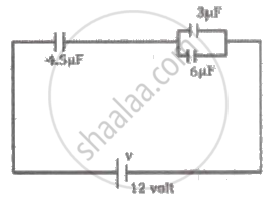
In the circuit shown, the potential difference across the 4.5 µF capacitor is ______.
Potential energy as a function of r is given by U = `"A"/"r"^10-"B"/"r"^5`, where r is the interatomic distance, A and B are positive constants. The equilibrium distance between the two atoms will be ______.
State the formula giving the relation between electric field intensity and potential gradient.
Derive the relation between electric intensity and electric potential.
The potential difference (VA - VB) between the points A and B in the given figure is______.
Three point charges + Q + 2Q and q are placed at the vertices of an equilateral triangle. The value of charge q in terms of Q so that electrical potential energy of the system is zero, is given by ______.
A conducting sphere of radius 'R' is given a charge 'Q' uniformly. The electric field and the electric potential at the centre of the sphere are respectively [ε0 = permittivity of free space] ______.
A hollow charged metal sphere has a radius ‘r’. If the potential difference between its surface and a point at a distance ‘3r’ from the centre is ‘v’, then the electric field intensity at a distance ‘3r’ is ______.
