Advertisements
Advertisements
प्रश्न
There are no substitute goods in a monopoly market. Give a reason to support your answer.
Advertisements
उत्तर १
- In a monopoly market, there are no substitute goods because the monopolist is the sole producer or provider of a unique product or service that no other firm offers.
- This absence of close substitutes means that consumers cannot switch to an alternative product if they find the monopolist's product too expensive or unsatisfactory.
- The monopolist's product is the only available option in the market, giving the monopolist significant control over pricing and market conditions.
- A monopoly's lack of competition from substitute goods is a defining feature, reinforcing the firm's dominant position in the market.
उत्तर २
The government may issue a license to a single producer to produce a specific commodity. As a result, a monopoly emerges. In addition, the government may elect to control the manufacture of specific items exclusively through departmental undertakings, such as India's railways. As a result, there are no close substitutes for the monopolistic product in the market. For example, there is no comparable 'bulk carrier' to railways.
संबंधित प्रश्न
Define Discriminating Monopoly.
Identify the market having a single buyer and many sellers from the following:
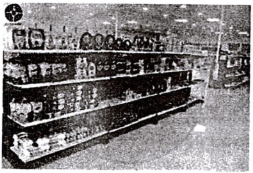
The image above shows a departmental store of a market structure.
- Identify the form of market as observed from the above image.
- Discuss the features of this market form with respect to:
- Type of product
- Entry and exit of firms
- Selling cost
What is the shape of the demand curve faced by any monopoly firm? Support your answer with a diagram.
Following is the feature of perfect competition:
Marginal revenue of a firm is constant throughout under:
Indian Oil Corporation Limited is an example of a/an ______.
Which one of the following is NOT found in a perfectly competition market?
Read the following statements carefully and choose the correct alternative:
Assertion (A): Price discrimination is possible under monopoly.
Reason (R): A monopolist can charge different prices in different markets because different sets of consumers - rich and poor - have different price elasticity of demand for the monopolist's product.
Give an example of monopsony.
State the advantage of monopolistic competition over monopoly.
Identify the market form for the following:
Textile industry in India.
Identify the market form for the following:
Perfectly elastic demand.
Identify the market form for the item given below:
Homogeneous goods
Which type of market structure is the following? Give reason.
Trucks
Which type of market structure is the following? Give reason.
Lipstick
To which market is price discrimination relevant?
What is meant by barriers to entry?
Elaborate the price discrimination feature of monopoly.
