Advertisements
Advertisements
प्रश्न
The variation of image distance (u) with the object distance (u) for a convex lens is given in the following observation table. Analyse it and answer the questions given below:
| S. No. | Object distance (u) cm |
Image distance (v) cm |
| 1 | −150 | +30 |
| 2 | −75 | +37.5 |
| 3 | −50 | +50 |
| 4 | −37.5 | +75 |
| 5 | −30 | +150 |
| 6 | −15 | +37.5 |
- Without calculation, find out the focal length of the given convex lens. Justify your answer. (1)
- Which one of the observations given in the table is not correct and why? (1)
-
- Find out the value of magnification for u = −30 cm. Write the nature of the image formed. Give a reason for your answer. (2)
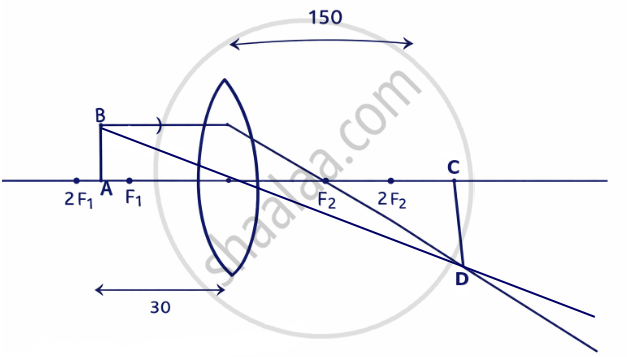
OR - Analyse the data given in the table above and draw the labelled ray diagram for u = −30 cm and v = 150 cm. (2)
- Find out the value of magnification for u = −30 cm. Write the nature of the image formed. Give a reason for your answer. (2)
Advertisements
उत्तर
(a) From the table, observe:
When u = –50 cm, v = +50 cm
For a convex lens, when object distance = image distance (in magnitude), the object is at 2f.
So, 2f = 50
f = `50/2`
f = 25 cm
Therefore, the focal length of the convex lens is 25 cm.
(b) Use the lens formula:
`1/f = 1/v - 1/u`
Checking the last entry: u = –15 cm, v = +37.5 cm
`1/v - 1/u = 1/37.5 - (1/-15)`
= `1/37.5 + 1/15`
= `(2 + 5)/75`
= `7/75`
f = `75/7` ≈ 10.7 cm (not 25 cm)
This does not match the focal length. It does not satisfy the lens formula for f = 25 cm.
(c) (i) Given, u = −30 and v = +150
`m = v/u = 150/-30 = -5`
The negative sign of magnification (m = −5) indicates that the image is real and inverted, while the magnitude greater than 1 (5 > 1) confirms that the image is enlarged.
OR
(ii)