हिंदी

The V-I graph for a series combination and for a parallel combination of two resistors is as shown in the figure alongside. Which of the two A or B represents the parallel combination?

Advertisements
Advertisements

प्रश्न

The V-I graph for a series combination and for a parallel combination of two resistors is as shown in the figure alongside. Which of the two A or B represents the parallel combination? Give a reason for your answer.
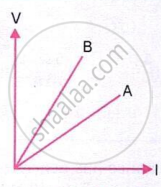
The graph shows the relationship between voltage (V) and current (I) for two conductors A and B. Conductor B has higher resistance than conductor A, as its V–I graph has a steeper slope.

लघु उत्तरीय
Advertisements

उत्तर

A represents the parallel combination. In a voltage–current graph, the slope is resistance; a parallel combination has a lower equivalent resistance than a series combination. The graph for A has the smaller slope.

shaalaa.com
  क्या इस प्रश्न या उत्तर में कोई त्रुटि है?
अध्याय 4: Electricity and Magnetism - Frequently Asked Questions in Board Examination [पृष्ठ २८४]

APPEARS IN

फ्रैंक Physics Part 2 [English] Class 10 ICSE
अध्याय 4 Electricity and Magnetism
Frequently Asked Questions in Board Examination | Q 23. | पृष्ठ २८४
Share
Notifications

Englishहिंदीमराठी


      Forgot password?
Use app×