Advertisements
Advertisements
प्रश्न
The two opposite vertices of a square are (− 1, 2) and (3, 2). Find the coordinates of the other two vertices.
Advertisements
उत्तर
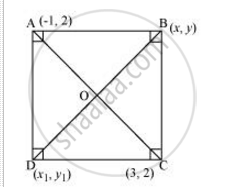
Let ABCD be a square having (−1, 2) and (3, 2) as vertices A and C respectively. Let (x, y), (x1, y1) be the coordinate of vertex B and D respectively.
We know that the sides of a square are equal to each other.
∴ AB = BC
`=>sqrt((x+1)^2 + (y-2)^2) = sqrt((x-3)^2 + (y-2)^2)`
=>x2 + 2x + 1 + y2 -4y + 4 = x2 + 9 -6x + y2 + 4 - 4y
⇒ 8x = 8
⇒ x = 1
We know that in a square, all interior angles are of 90°.
In ΔABC,
AB2 + BC2 = AC2
`=> (sqrt(((1+1)^2)+(y-2)^2))^2 + (sqrt(((1-3)^2)+(y-2)^2))^2 = (sqrt((3+1)^2+(2-2)^2))^2`
⇒ 4 + y2 + 4 − 4y + 4 + y2 − 4y + 4 =16
⇒ 2y2 + 16 − 8 y =16
⇒ 2y2 − 8 y = 0
⇒ y (y − 4) = 0
⇒ y = 0 or 4
We know that in a square, the diagonals are of equal length and bisect each other at 90°. Let O be the mid-point of AC. Therefore, it will also be the mid-point of BD
Coordinate of point O = ((-1+3)/2, (2+2)/2)
`((1+x_1)/2, (y+ y_1)/2) = (1,2)`
`(1+x_1)/2 = 1`
1+x1=2
x1 =1
and
` (y + y_1)/2 = 2`
⇒ y + y1 = 4
If y = 0,
y1 = 4
If y = 4,
y1 = 0
Therefore, the required coordinates are (1, 0) and (1, 4).
