Advertisements
Advertisements
प्रश्न
The three vertices of a parallelogram ABCD are A(–3, –4), B(2, –2) and C(2, 6). Plot these points on a graph paper and find the co-ordinates of the fourth vertex. Also find the area of the parallelogram.
Advertisements
उत्तर
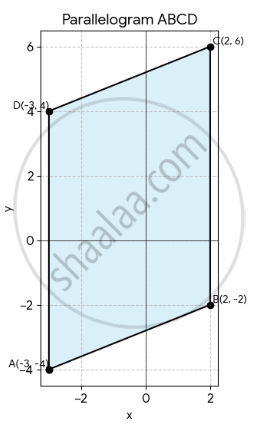
The coordinates of the fourth vertex are D(–3, 4) and the area of the parallelogram is 40 square units.
1. Find the fourth vertex D(x, y)
In a parallelogram, the diagonals bisect each other. This means the midpoint of diagonal AC is the same as the midpoint of diagonal BD.
Midpoint of AC:
`M = ((-3 + 2)/2, (-4 + 6)/2)`
= `(- 1/2, 1)`
Midpoint of BD:
Using vertex B(2, –2) and unknown D(x, y):
`((2 + x)/2, (-2 + y)/2)`
= `(- 1/2, 1)`
Equating the coordinates:
1. `(2 + x)/2 = -1/2`
⇒ 2 + x = –1
⇒ x = –3
2. `(-2 + y)/2 = 1`
⇒ –2 + y = 2
⇒ y = 4
Thus, the coordinates of D are (–3, 4).
2. Calculate the area
The area of a parallelogram can be calculated using the formula:
Area = Base × Height
Base (BC): The segment BC is a vertical line because both x-coordinates are 2.
Length of BC
= |yC – yB|
= |6 – (–2)|
= 8 units
Height (h): The height is the perpendicular distance between the vertical lines x = 2 (side BC) and x = –3 (side AD).
h = |xBC – xAD|
= |2 – (–3)|
= 5 units
Area = 8 × 5
= 40 sq units
The coordinates of the fourth vertex are D(–3, 4) and the area of the parallelogram is 40 square units.
