Advertisements
Advertisements
प्रश्न
The sides of a quadrilateral, taken in order are 5, 12, 14 and 15 meters respectively, and the angle contained by the first two sides is a right angle. Find its are
Advertisements
उत्तर
Given that sides of quadrilateral are AB = 5 m, BC = 12 m, CD = 14 m and DA = 15 m
AB = 5m, BC = 12m, CD = 14 m and DA = 15 m
Join AC
Area of ΔABC = `1/2`×𝐴𝐵×𝐵𝐶 [∵𝐴𝑟𝑒𝑎 𝑜𝑓 Δ𝑙𝑒=`1/2`(3𝑥+1)]
= `1/2×5×12`
= 30 cm2
In ΔABC By applying Pythagoras theorem.
`AC^2=AB^2+BC^2`
`⇒AC=sqrt(5^2+12^2)`
`⇒sqrt(25+144)`
`⇒sqrt169=13m`
𝑁𝑜𝑤 𝑖𝑛 Δ𝐴𝐷𝐶
Let 2s be the perimeter
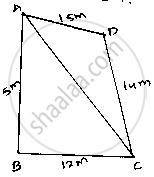
∴ 2s = (AD + DC + AC)
⇒ S = `1/2`(15+14+13)=`1/2`×42=21𝑚
By using Heron’s formula
∴ Area of ΔADC = `sqrt(S(S-AD)(S-DC)(S-AC))`
`=sqrt(21(21-15)(21-14)(21-13))`
`sqrt(21xx6xx7xx8)`
∴𝐴𝑟𝑒𝑎 𝑜𝑓 𝑞𝑢𝑎𝑑𝑟𝑖𝑙𝑎𝑡𝑒𝑟𝑎𝑙 𝐴𝐵𝐶𝐷=𝑎𝑟𝑒𝑎 𝑜𝑓 (Δ𝐴𝐵𝐶)+𝐴𝑟𝑒𝑎 𝑜𝑓 (Δ𝐴𝐷𝐶) = 30 + 84 = `114 m^2`
APPEARS IN
संबंधित प्रश्न
Find the area of a quadrilateral ABCD in which AB = 3 cm, BC = 4 cm, CD = 4 cm, DA = 5 cm and AC = 5 cm.
A triangle and a parallelogram have the same base and the same area. If the sides of triangle are 26 cm, 28 cm and 30 cm, and the parallelogram stands on the base 28 cm, find the height of the parallelogram.
Find the area of a quadrilateral ABCD is which AB = 3 cm, BC = 4 cm, CD = 4 cm, DA = 5 cm and AC = 5 cm.
Find the area of a quadrilateral ABCD in which AD = 24 cm, ∠BAD = 90° and BCD forms an equilateral triangle whose each side is equal to 26 cm. (Take √3 = 1.73)
Let Δ be the area of a triangle. Find the area of a triangle whose each side is twice the side of the given triangle.
The base and hypotenuse of a right triangle are respectively 5 cm and 13 cm long. Its area is ______.
If the area of an isosceles right triangle is 8 cm2, what is the perimeter of the triangle?
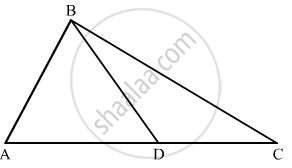
In the given figure, the ratio AD to DC is 3 to 2. If the area of Δ ABC is 40 cm2, what is the area of Δ BDC?
If the length of a median of an equilateral triangle is x cm, then its area is
In a triangle, the sides are given as 11 cm, 12 cm and 13 cm. The length of the altitude is 10.25 cm corresponding to the side having length 12 cm.
