Advertisements
Advertisements
प्रश्न
The salt is formed when concentrated sulphuric acid reacts with KNO3 above 200°C.
विकल्प
K2SO4
K2SO3
KHSO4
KHSO3
Advertisements
उत्तर
K2SO4
Explanation:
Potassium sulphate is formed when an acid completes neutralization above 200°C.
\[\ce{Conc{.} H2SO4 + 2KNO3 -> K2SO4 + 2HNO3}\]
संबंधित प्रश्न
A, B, C, and D summarize the properties of sulphuric acid depending on whether it is dilute or concentrated.
A = Typical acid property
B = Non volatile acid
C = Oxidizing agent
D = Dehydrating agent
Choose the property (A, B, C or D) depending on which is relevant to each of the following
1) Preparation of Hydrogen chloride gas
2) Preparation of Copper sulphate from copper oxide.
3) An action of conc. Sulphuric acid on Sulphur.
Distinguish between the given pair of compounds using the test given within brackets:
Sodium nitrate and sodium sulphite (using dilute sulphuric acid).
Name the following:
Gases obtained by treating carbon with hot concentrated sulphuric acid.
What would you observe in the following case?
Hot concentrated sulphuric acid is added to sodium chloride crystals.
Why is sulphuric acid known as king of chemicals and oil vitriol ?
Give examples of the use of sulphuric acid as
An oxidizing agent
Copy and complete the following table.
Column 3 has the names of gases to be prepared using the substance you enter in column 1, along with dilute or concentrated sulphuric acid, as indicated in column 2.
| Column 1 | Column 2 | Column 3 |
| Substance reacted with acid | Dilute or concentrated sulphuric acid | Gas |
| Hydrogen | ||
| Carbon dioxide | ||
| Only chlorine |
Write the equation for the laboratory preparation of :
(i) Sodium sulphate using dilute sulphuric acid.
(ii) Lead sulphate using dilute sulphuric acid.
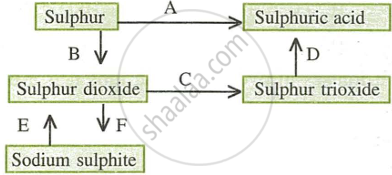
- Name the catalyst which helps in the conversion of sulphur dioxide to sulphur trioxide in step C.
- In the contact process for the manufacture of sulphuric acid, sulphur trioxide is not converted to sulphuric acid by reacting it with water. Instead a two-step procedure is used. Write the equations for the two steps involved in D.
- What type of substance will liberate sulphur dioxide from sodium sulphite in step E?
- Write the equation for the reaction by which sulphur dioxide is converted to sodium sulphite in step F.
Dilute hydrochloric acid and dilute sulphuric acid are both colourless solutions. How will the addition of barium chloride solution to each help to distinguish between the two?
A, B and C are the chemical properties of sulphuric acid:
A. Oxidizing agent
B. Dehydrating agent
C. Non-volatile acid
Match the following equations 1 to 3 to the above chemical properties of sulphuric acid.
1. \[\ce{KNO3 + H2SO4 -> KHSO4 + HNO3}\]
2. \[\ce{C12H22O11 -> 12C + 11H2O}\]
3. \[\ce{S + 2H2SO4 -> 2H2O + 3SO2}\]
