Advertisements
Advertisements
प्रश्न
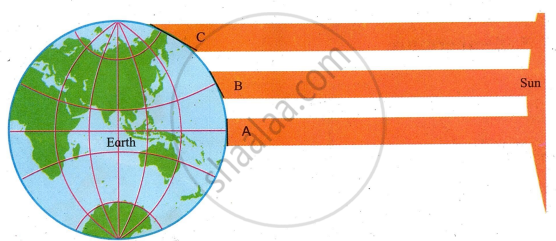
The region marked 'A' in figure receives perpendicular rays, while the region marked 'B' receives slant rays and in the region marked 'C' the rays are extremely slanting.
- Using a scale, measure the lengths of the lit up portions on the earth's surface in A, B and C regions.
- Measure the width of the rays shown between the earth and the sun.
- Considering the parallels of latitude marked in the figure, tell the regions where the temperature will be high, moderate and low.
- Discuss this in the class and write the answers in your notebook.
विस्तार में उत्तर
Advertisements
उत्तर
-
Length of the lit-up portions:
- In region A, the illuminated area is the smallest because the Sun’s rays fall almost perpendicular.
- In region B, the illuminated area is larger because the rays are slanting.
- In region C, the illuminated area is the largest because the rays are extremely slanting.
-
Width of the rays: The width of the Sun’s rays between the Sun and the Earth remains nearly the same.
-
Temperature according to latitude:
- High temperature: Near the Equator and Torrid Zone.
- Moderate temperature: In the Temperate Zones.
- Low temperature: Near the Frigid Zones and poles.
Conclusion: Perpendicular rays concentrate heat over a smaller area and produce higher temperatures. Slanting rays spread the same heat over a larger area, so the temperature becomes lower.
shaalaa.com
क्या इस प्रश्न या उत्तर में कोई त्रुटि है?
