हिंदी

The Population of a Village Increases Continuously at the Rate Proportional to the Number of Its Inhabitants Present at Any Time. If the Population of the Village Was 20000 in 1999 and 25000 in the Year 2004, What Will Be the Population of the Village in 2009? - Mathematics

Advertisements
Advertisements

प्रश्न

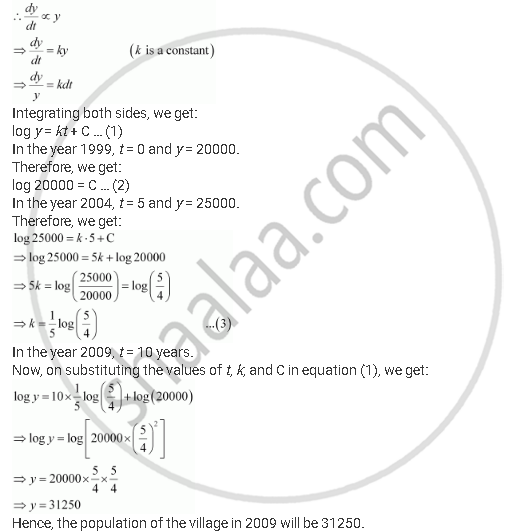
The population of a village increases continuously at the rate proportional to the number of its inhabitants present at any time. If the population of the village was 20000 in 1999 and 25000 in the year 2004, what will be the population of the village in 2009?

Advertisements

उत्तर

Let the population at any instant (t) be y.

It is given that the rate of increase of population is proportional to the number of inhabitants at any instant.
shaalaa.com
  क्या इस प्रश्न या उत्तर में कोई त्रुटि है?
अध्याय 9: Differential Equations - Exercise 9.7 [पृष्ठ ४२१]

APPEARS IN

एनसीईआरटी Mathematics Part 1 and 2 [English] Class 12
अध्याय 9 Differential Equations
Exercise 9.7 | Q 15 | पृष्ठ ४२१

वीडियो ट्यूटोरियलVIEW ALL [1]

संबंधित प्रश्न

Find the the differential equation for all the straight lines, which are at a unit distance from the origin.


For the differential equation, find the general solution:

`dy/dx + (sec x) y = tan x (0 <= x < pi/2)`


For the differential equation, find the general solution:

`x dy/dx +  2y= x^2 log x`


For the differential equation, find the general solution:

`x dy/dx + y - x + xy cot x = 0(x != 0)`


For the differential equation given, find a particular solution satisfying the given condition:

`dy/dx + 2y tan x = sin x; y = 0 " when x " = pi/3`


For the differential equation given, find a particular solution satisfying the given condition:

`dy/dx - 3ycotx = sin 2x; y = 2`  when `x = pi/2`


The Integrating Factor of the differential equation `dy/dx - y = 2x^2` is ______.


Solve the differential equation `(tan^(-1) x- y) dx = (1 + x^2) dy`


\[\left( 1 + x^2 \right)\frac{dy}{dx} + y = e^{tan^{- 1} x}\]

x dy = (2y + 2x4 + x2) dx


(x + tan y) dy = sin 2y dx


\[\frac{dy}{dx}\] + y cos x = sin x cos x


Find the general solution of the differential equation \[x\frac{dy}{dx} + 2y = x^2\]


Find the general solution of the differential equation \[\frac{dy}{dx} - y = \cos x\]


Find the particular solution of the differential equation \[\frac{dx}{dy} + x \cot y = 2y + y^2 \cot y, y ≠ 0\] given that x = 0 when \[y = \frac{\pi}{2}\].


Solve the differential equation \[\frac{dy}{dx}\] + y cot x = 2 cos x, given that y = 0 when x = \[\frac{\pi}{2}\] .


Solve the following differential equation:-
\[\left( 1 + x^2 \right)\frac{dy}{dx} - 2xy = \left( x^2 + 2 \right)\left( x^2 + 1 \right)\]


Solve the following differential equation:

`dy/dx + y/x = x^3 - 3`


Solve the following differential equation:

`("x" + 2"y"^3) "dy"/"dx" = "y"`


Solve the following differential equation:

`"dy"/"dx" + "y" * sec "x" = tan "x"`


Solve the following differential equation:

`("x + y") "dy"/"dx" = 1`


Solve the following differential equation:

dr + (2r cotθ + sin2θ)dθ = 0


Find the equation of the curve which passes through the origin and has the slope x + 3y - 1 at any point (x, y) on it.


Form the differential equation of all circles which pass through the origin and whose centers lie on X-axis.


The integrating factor of `(dy)/(dx) + y` = e–x is ______.


The slope of the tangent to the curves x = 4t3 + 5, y = t2 - 3 at t = 1 is ______


The solution of `(1 + x^2) ("d"y)/("d"x) + 2xy - 4x^2` = 0 is ______.


The equation x2 + yx2 + x + y = 0 represents


Let y = y(x) be a solution curve of the differential equation (y + 1)tan2xdx + tanxdy + ydx = 0, `x∈(0, π/2)`. If `lim_(x→0^+)` xy(x) = 1, then the value of `y(π/2)` is ______.


Let y = f(x) be a real-valued differentiable function on R (the set of all real numbers) such that f(1) = 1. If f(x) satisfies xf'(x) = x2 + f(x) – 2, then the area bounded by f(x) with x-axis between ordinates x = 0 and x = 3 is equal to ______.


Let y = y(x) be the solution curve of the differential equation `(dy)/(dx) + ((2x^2 + 11x + 13)/(x^3 + 6x^2 + 11x + 6)) y = ((x + 3))/(x + 1), x > - 1`, which passes through the point (0, 1). Then y(1) is equal to ______.


Let the solution curve y = y(x) of the differential equation (4 + x2) dy – 2x (x2 + 3y + 4) dx = 0 pass through the origin. Then y (2) is equal to ______.


If the solution curve y = y(x) of the differential equation y2dx + (x2 – xy + y2)dy = 0, which passes through the point (1, 1) and intersects the line y = `sqrt(3)  x` at the point `(α, sqrt(3) α)`, then value of `log_e (sqrt(3)α)` is equal to ______.


If the slope of the tangent at (x, y) to a curve passing through `(1, π/4)` is given by `y/x - cos^2(y/x)`, then the equation of the curve is ______.


If sin x is the integrating factor (IF) of the linear differential equation `dy/dx + Py` = Q then P is ______.


Share
Notifications

Englishहिंदीमराठी


      Forgot password?
Use app×