Advertisements
Advertisements
प्रश्न
The number of periods and groups in the periodic table are ______
विकल्प
6, 16
7, 17
8, 18
7, 18
Advertisements
उत्तर
The number of periods and groups in the periodic table is 7, 18.
APPEARS IN
संबंधित प्रश्न
Write the electronic configuration of two elements X and Y whose atomic numbers are 20 and 17 respectively. Write the molecular formula of the compound formed when element X reacts with element Y. Draw the electron-dot structure of the product and also state the nature of the bond formed between both the elements.
An element X combines with oxygen to form an oxide XO. This oxide is electrically conducting.
(a) How many electrons would be there in the outermost shell of the element X?
(b) To which group of the periodic tables does the element X belong?
(c) Write the formula of the compound formed when X reacts with chlorine.
An element X (atomic number 17) reacts with an element Y (atomic number 20) to form a compound.
(a) Write the position of these elements in the modern periodic table.
(b) Write the formula of the compound formed.
Justify your answer in each case.
The number of electrons in the outermost shell of alkali metals is ______.
(a) How is possible valency of an element determined from the electronic configuration of its atom ?
(b) Determine the valency of an element X whose atomic number is 15.
Which one of the following statements is not correct about the trends in the properties of the elements of a period on going from left to right?
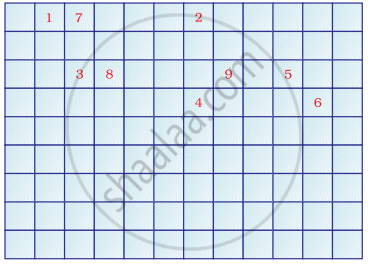
Complete the following cross word puzzle
Across:
(1) An element with atomic number 12.
(3) Metal used in making cans and member of Group 14.
(4) A lustrous non-metal which has 7 electrons in its outermost shell.
Down:
(2) Highly reactive and soft metal which imparts yellow colour when subjected to flame and is kept in kerosene.
(5) The first element of second Period
(6) An element which is used in making fluorescent bulbs and is second member of Group 18 in the Modern Periodic Table
(7) A radioactive element which is the last member of halogen family.
(8) Metal which is an important constituent of steel and forms rust when exposed to moist air.
(9) The first metalloid in Modern Periodic Table whose fibres are used in making bullet-proof vests
Complete the following table:
| Symbol | Atomic No | Electronic Configuration | |
| 1. | He | 2 | ______ |
| 2. | Ne | ______ | 2,8 |
| 3. | Ar | ______ | 2, 8,8 |
| 4. | Na | 11 | ______ |
The atomic number of an element 'X' is 11.
- Write the electronic configuration of X and find its valency.
- Write the formula and nature of its oxide.
Element ‘X’ forms an oxide with the formula X2O3 which is a solid with high melting point. ‘X’ would most likely be placed in the group of the Periodic Table as:
-
- Na
- Mg
- Al
- Si
- Justify your answer in the above question (1).
