Advertisements
Advertisements
प्रश्न
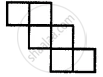
The following figure represent the nets of some solid. Name the solid
Advertisements
उत्तर
The given nets of the solid is a cube
संबंधित प्रश्न
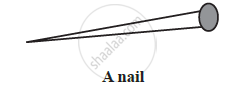
The given Figure are prisms or not?
Can a polyhedron have for its face a square and four triangles?
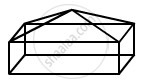
Verify Euler's formula for the following polyhedron:
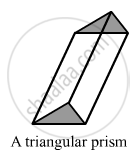
Draw net for the following polyhedron :
If a polyhedron has 10 faces and 8 vertices, find the number of edges in it.
State, the number of faces, number of vertices and number of edges of:
(i) a pentagonal pyramid
(ii) a hexagonal prism
The figure, given below, shows shadows of some 3D object when seen under the lamp of an overhead projector:
A square
In this case, name the object.
The dimensions of a cuboid are 6 cm, 4 cm and 3 cm. Draw two different types of oblique sketches for this cuboid.
Verify Euler’s formula for the table given below.
| Faces | Verticles | Edges |
| 4 | 4 | 6 |
Verify Euler’s formula for the table given below.
| Faces | Vertices | Edges |
| 20 | 13 | 30 |
A solid figure with only 1 vertex is a ______.
The number of edges in a parallelogram is 4.
How many faces does the following solid have?
Hexahedron
How many vertices does the following solid have?
Cone
How many vertices does the following solid have?
Sphere
How many vertices does the following solid have?
Octagonal Pyramid
How many edges does the following solid have?
Hexagonal Prism
Find the number of faces in the given shape:
Find the number of faces in the given shape:

How many faces does a cylinder have?
