Advertisements
Advertisements
प्रश्न
The figure shows three ammeters A, B and C The ammeter B reads 0.5 A . If all ammeters have negligible resistance calculate:
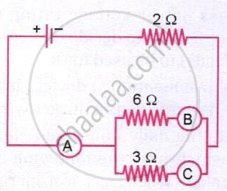
(a) reading of ammeters C and A.
(b) the total resistance of the circuit.
संख्यात्मक
Advertisements
उत्तर
Ammeter B measures the current through the \(6\ \Omega\) branch.
(a) The potential difference across the parallel branches is:
\[V=IR\]
\[=0.5\times6\]
\[=3\ \mathrm{V}\]
Thus the current through the (3\ \Omega) branch, measured by C, is:
\[I_C=\frac{3}{3}\]
= 1 A
The total current, measured by A, is:
\[I_A=0.5+1\]
= 1.5 A
(b) The parallel pair has resistance:
\[R_p=\frac{6\times3}{6+3}\]
= 2 Ω
Adding the series \(2\ \Omega\) resistor gives:
\[R_{\mathrm{total}}=2+2\]
= 4 Ω
shaalaa.com
क्या इस प्रश्न या उत्तर में कोई त्रुटि है?
