Advertisements
Advertisements
प्रश्न
The figure shows a big triangle in which multiple other triangles can be seen. Observe the pattern of dark shaded and light unshaded triangles starting with one triangle in row 1, three triangles in row 2, five triangles in row 3 and so on.
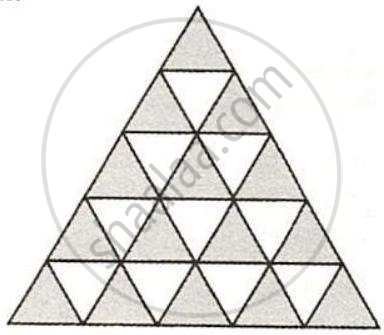
Based on the above information, answer the following questions:
- How many triangles will be there in the 15th row?
- In which row will the number of triangles be 47?
- The number of dark shaded triangles in each row are in A.P. Find the total number of dark shaded triangles in the first 15 rows.
Advertisements
उत्तर
(i) Number of triangles in rows are in A.P.:
1, 3, 5, 7, 9,....
We know that,
an = a + (n − 1)d
⇒ a15 = 1 + (15 − 1).2
= 1 + 14 × 2
= 1 + 28
= 29
Hence, 29 triangles will be there in the 15th row.
(ii) We know that,
an = a + (n − 1)d
Let 47 triangles be there in n rows.
⇒ 47 = 1 + (n − 1).2
⇒ 47 − 1 = 2(n − 1)
⇒ `46/2` = (n − 1)
⇒ 23 = (n − 1)
⇒ n = 23 + 1
⇒ n = 24
Hence, 47 triangles occur in 24th row.
(iii) In first row, there is 1 dark shaded triangle, in 2nd row there are 2, in 3rd row there are 3.
Thus, the dark shaded triangle are in A.P. with first term (a) = 1 and common difference (d) = 1.
By formula,
`S_n = n/2[2a+(n−1)d]`
Substituting values, we get:
⇒ `S_15 = 15/2[2(1)+(15−1)1]`
152 × [2 + 14]
= 152 × 16
= 15 × 8
= 120
Hence, total number of dark shaded triangles in the first 15 rows = 120.
