Advertisements
Advertisements
प्रश्न
The equation I2R seems to suggest that the rate of heating in a resistor is reduced if resistance decreases, whereas equation P = V2/R suggests just the opposite. How do you reconcile this problem?
Advertisements
उत्तर
There is no contradiction in the relation. It V is constant, on decreasing resistance, the current increases and so as P = I2R the same result we gets from equation P = V2/R.
संबंधित प्रश्न
What determines the rate at which energy is delivered by a current?
Name the commercial unit of electric energy.
The diagram below shows a circuit containing a lamp L, a voltmeter and an ammeter,. The voltmeter reading 3 V and the ammeter reading is 0.5 A.
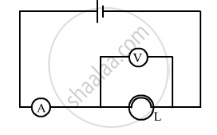
What is the resistance of the lamp?
What is the power of the lamp?
Define kilowatt-hour.
An electric bulb is rated ‘100 W, 250 V’. How much current will the bulb draw if connected to a 250 V supply?
An electric kettle is rated 2.5 kW, 250 V. Find the cost of running the kettle for two hours at Rs. 5.40 per unit.
The coil of an electric bulb takes 40 watts to start glowing. If more than 40 W are supplied, 60% of the extra power is converted into light and the remaining into heat. The bulb consumes 100 W at 220 V. Find the percentage drop in the light intensity at a point if the supply voltage changes from 220 V to 200 V.
Define electric power. An electrical device of resistance R is connected across a source of voltage V and draws a current I. Derive an expression for power in terms of current and resistance.
Express watt hour and kilowatt hour in joule.
An Electric bulb is marked 100 W, 230 V. What how long would this lamp take to consume one unit of electricity?
