Advertisements
Advertisements
प्रश्न
The diagram shows an experimental set up for the laboratory preparation of a pungent smelling gas. The gas is alkaline in nature.
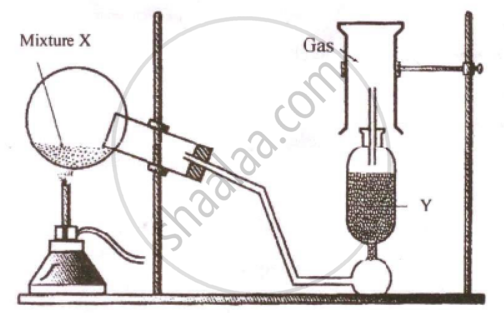
- Nature the gas collected in the jar.
- Write the balance equation for the above preparation.
- How is the gas being collected?
- Name the drying agent used.
- How will you find that the jar is full of gas?
The diagram below shows the set up for the laboratory preparation of a pungent alkaline gas.
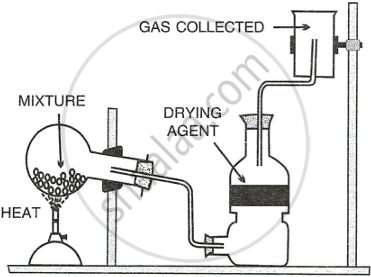
- Name the gas collected in the jar.
- Give a balanced equation for the above preparation.
- State how the above gas is collected.
- Name the drying agent used.
- State how you will find out that the jar is full of the pungent gas.
Advertisements
उत्तर
- Ammonia
- \[\ce{NH4Cl + Ca(OH)2 ->[Heat] CaCl2 + 2H2O + 2NH3↑}\]
- By downward displacement of air.
- Quicklime (CaO)
- Bring moist red litmus paper to the mouth of the inverted jar; it immediately turns blue.
Or
Bring a glass rod dipped in hydrochloric acid to the mouth of the inverted jar. If it produces dense white fumes, then the jar is full of gas.
APPEARS IN
संबंधित प्रश्न
Is ammonia more dense or less dense than air?
Name two gases which give dense white fumes with ammonia.
Describe two tests to identify ammonia and ammonium ions in an aqueous solution.
Choose the correct word or phrase from the bracket to complete the following sentence:
Heating ammonium chloride with sodium hydroxide produces ______.
Choose the correct word or phrase from the bracket to complete the following sentences.
Heating solution of ammonium chloride with sodium nitrite produces ______
Name the gas evolved when the following mixtures are heated.
Calcium hydroxide and ammonium chloride.
Of the two gases, ammonia and hydrogen chloride, which is denser? Name the method of collection of this gas.
- Of the two gases, ammonia and hydrogen chloride, which is more dense? Name the method of collection of this gas.
- Give one example of a reaction between the above two gases which produce a solid compound.
- Write the balanced equation for a reaction in which ammonia is oxidized by:
- a metal oxide,
- a gas which is not oxygen.
