Advertisements
Advertisements
प्रश्न
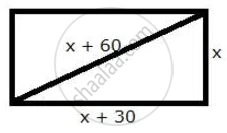
The diagonal of a rectangle is 60 m more than its shorter side and the larger side is 30 m more than the shorter side. Find the sides of the rectangle.
Advertisements
उत्तर

Let the shorter side be x m.
Length of the other side = (x + 30) m
Length of hypotenuse = (x + 60) m
Using Pythagoras theorem,
(x + 60)2 = x2 + (x + 30)2
x2 + 3600 + 120x = x2 + x2 + 900 + 60x
x2 – 60x – 2700 = 0
x2 – 90x + 30x – 2700 = 0
x(x – 90) + 30(x – 90) = 0
(x – 90)(x + 30) = 0
x = 90, –30
But, x cannot be negative.
So, x = 90.
Thus, the sides of the rectangle are 90 m and (90 + 30) m = 120 m.
संबंधित प्रश्न
The hypotenuse of a right-angled triangle is 26 cm and the sum of other two sides is 34 cm. Find the lengths of its sides.
The sides of a right-angled triangle are (x – 1) cm, 3x cm and (3x + 1) cm. Find:
- the value of x,
- the lengths of its sides,
- its area.
The perimeter of a rectangle is 104 m and its area is 640 m2. Find its length and breadth.
Two squares have sides x cm and (x + 4) cm. The sum of their area is 656 sq. cm. Express this as an algebraic equation in x and solve the equation to find the sides of the squares.
The dimensions of a rectangular field are 50 m and 40 m. A flower bed is prepared inside this field leaving a gravel path of uniform width all around the flower bed. The total cost of laying the flower bed and gravelling the path at Rs. 30 and Rs. 20 per square metre, respectively, is Rs. 52,000. Find the width of the gravel path.
A square lawn is bounded on three sides by a path 4 m wide. If the area of the path is `7/8` that of the lawn, find the dimensions of the lawn.
The area of a big rectangular room is 300 m2. If the length were decreased by 5 m and the breadth increased by 5 m; the area would be unaltered. Find the length of the room.
A car made a run of 390 km in ‘x’ hours. If the speed had been 4 km/hour more, it would have taken 2 hours less for the journey. Find ‘x’.
The perimeter of a rectangular field is 28 m and its area is 40 sq. m. Its sides are ______.
The perimeter of a square is numerically equal to its area. The perimeter of the square is ______.